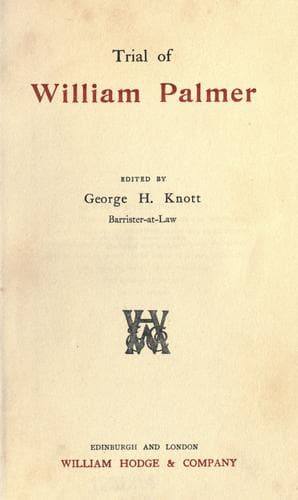
Cook, John Parsons, -1855; Palmer, William, 1824-1856 -- Trials, litigation, etc.; Trials (Murder) -- England -- London
But in this case you are speaking as if it ended in the first
paroxysm?--Yes.
How then can you be justified, in cases where you discover no abnormal
conditions of the heart or its arteries, in setting down the death to
angina?--Precisely as if I saw the symptoms of epilepsy I should accept
them as such.
Supposing the disease was referable to two causes, in the absence of all
evidence, what is your reason for setting it down to one in preference
to the other?--I quite admit that if I had known as much of the nature
of strychnia as I do now I should have gone on to make analysis.
Is the disease of angina pectoris attended with painful symptoms before
it terminates in death?--Most painful. The paroxysms terminating in
death may run on for more than eight minutes. It comes on suddenly. It
does not always kill at the first attack. It generally spreads itself
over a certain period of time.
You said that the head was somewhat bent back. Was that
opisthotonos?--There was rigidity, not amounting to opisthotonos, but
still very marked. The neck was so stiffly bent back that if the body
had been laid down, and the lower limbs, which I did not see, had been
the same, I have no doubt the body would be resting on its head and
heels.
You say in epileptic convulsions you have seen the hands clenched firmly
till death. Did you ever see them so long after death?--I have seen them
firmly clenched, not in epilepsy only.
In what cases have you seen them firmly clenched after death?--In cases
where there has been violent convulsion. I saw them once from
hæmorrhage.
In other cases have you?--I can only say, in a general sense, I have
seen the hands clenched over and over again, and have paid no attention
to it. My belief, from seeing people die, is that the clenching of the
hands is, in many cases, mere matter of accident.
Re-examined by Mr. SERJEANT SHEE--Have you known cases personally or
from your reading where patients recover from angina pectoris, and
whether within a short time afterwards they sometimes have another
attack?--They do, sometimes in so short an interval as twenty-four
hours.
During the interval between the two attacks what is the condition of the
patient?--Perfectly healthy, to all appearance.
Are the symptoms described in the evidence more like the symptoms of
angina pectoris or strychnia poison?--I should certainly say angina
pectoris.
You had no reason to suspect poison of any kind in that case, either
before or now?--Not the slightest.
* * * * *
[Sidenote: Dr. Wrightson]
Public-domain text, read in full here on John Shaqi.
Reviews
Reviews
No reviews yet
Be the first to share your thoughts on this work.
Elsewhere in the archive
Join the Discussion
Join the discussion
Sign in to leave a comment or review.
Sign InorCreate an account