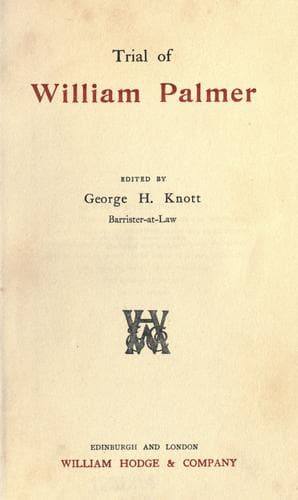
Cook, John Parsons, -1855; Palmer, William, 1824-1856 -- Trials, litigation, etc.; Trials (Murder) -- England -- London
But then comes another supposed condition from which death in this form
may be said to have resulted, and that is the case which was intended to
be set up by a very eminent practitioner, I mean Mr. Partridge. It seems
that in the post-mortem examination of Mr. Cook, when the spinal marrow
was investigated, certain granules were found, and this is seized upon.
It is said, “Oh, those granules may have occasioned tetanic convulsions
similar to those which were found in Mr. Cook’s case,” and a very
eminent gentleman is called to give his opinion upon that subject. I
admit him to be not only a man of great eminence, but a man of the
highest honour and the most perfect veracity. I allude to Mr. Partridge.
I must distinguish between him and other of my learned friend’s
witnesses. Some there were who would not be induced, for any
consideration in the world, to swerve from what they believed to be the
truth. Mr. Partridge is called here to prove that this was a case of
what he called arachnitis--inflammation of the arachnoid in consequence
of the granules, or some other abnormal condition. I asked him the
symptoms which he would find in such a case. I called his attention to
what evidently had not been done before, namely, the symptoms of Mr.
Cook’s case; and I asked him, in simple, straightforward terms,
whether, looking at those symptoms, he would pledge his opinion, in the
face of the medical world and the Court, that this was a case of
arachnitis, and he candidly admitted that he would not assert that this
was in his opinion a case of arachnitis.
Then we have the gentleman who comes all the way from Scotland to inform
us, as the next proposition, that Mr. Cook’s was a case of epileptic
convulsions with tetanic complications. Now, I asked him this question,
“Did you ever know a case of epilepsy, with or without tetanic
convulsions, in which consciousness was not destroyed before the patient
died?” He said, “No; I cannot say that I ever did, but I have read in
some book that such a case has occurred.” “Is there anything to make you
think that this was epilepsy?--Well, it may have been epilepsy, because
I do not know what else to ascribe it to; but I must admit that epilepsy
is characterised generally by a loss of consciousness.” “Well, then,
what difference would tetanic complications make?” That he is unable to
explain. I remind you of that species of evidence in which the witnesses
resorted to the most speculative reasoning, and put forward the barest
possibilities without the shadow of a foundation. But this I undertake
to assert, and I refer to the evidence to prove it, that there is not a
single case either to which they have spoken as coming within their own
experience, or of which they have spoken as the result of reading, in
which there were the formidable and decisive symptoms of marked tetanus
which existed in this case of Mr. Cook.
[Sidenote: Attorney-General]
Public-domain text, read in full here on John Shaqi.
Reviews
Reviews
No reviews yet
Be the first to share your thoughts on this work.
Elsewhere in the archive
Join the Discussion
Join the discussion
Sign in to leave a comment or review.
Sign InorCreate an account