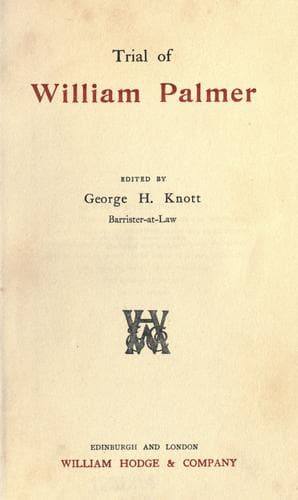
Cook, John Parsons, -1855; Palmer, William, 1824-1856 -- Trials, litigation, etc.; Trials (Murder) -- England -- London
inferior form, called bruchsia, is occasionally sold, and it may have
been that it failed in its effect. It is only one-tenth of the strength.
We know that he purchased poison on Tuesday, and that on that night Cook
died with all the symptoms of poison; and why he purchased that poison
is not in any way accounted for. The symptoms were the same on the
Tuesday night in character, though greater in degree, than they were on
the Monday; and there is found a witness who comes forward and says,
with no earthly motive to tell so foul a falsehood, “I found the
character of the convulsions the two succeeding nights the same.” I
cannot resist the conclusion to which my reasoning impels me that poison
was administered upon both nights, though it failed upon the first. I
can only speculate as to what was the cause of failure. There are the
facts, and you must deal with them.
[Sidenote: Attorney-General]
Alas! gentlemen, it does not stop there; there is another part of this
case which, though it may not have been the means of death, is of the
highest value in estimating the credit that is to be given to the point
which we advance of this death having been produced by strychnia--I
allude to the antimony. We have had medical men and analytical chemists
who have told us a great deal about strychnia, but not one has said a
word about antimony. On the Wednesday night, at Shrewsbury, when Cook
drinks his glass of brandy and water he fancies there is something in it
that burns his throat; he exclaims at the time, and he is seized
immediately with vomiting, which lasts for several hours. On that same
night Mrs. Brookes sees the prisoner shaking something in a glass,
evidently dissolving something in fluid. A man has been called here
to-day, the boon companion, the chosen associate, the racing confederate
of the prisoner, to come and tell you that all that story is
untrue--that the woman never came down stairs--that Palmer never carried
out the brandy and water--that there is not a word of truth in it--and
the fact is that Palmer and Cook only came in at twelve o’clock, when
Myatt, forsooth, had been waiting for two hours. Mrs. Brookes’ story is,
according to him, an entire invention from beginning to end; he swears
that he must have seen if anything had been mixed with the brandy and
water, and nothing was mixed with it. I think you will be more disposed
to believe Mrs. Brookes than to believe any of those persons who were
the associates of the prisoner, and who had been partners in his
transactions. It is a remarkable fact that Cook drinks that brandy
and water and a few minutes after is taken ill. There were other
persons taken ill at Shrewsbury; it may be within the verge of
possibility--although ten minutes after he had drunk the brandy and
water he was taken with vomiting--that it was the same form of complaint
to which other persons were subject in Shrewsbury; I do not want to
press it one jot further than it ought to go, but it is a remarkable
Public-domain text, read in full here on John Shaqi.
Reviews
Reviews
No reviews yet
Be the first to share your thoughts on this work.
Elsewhere in the archive
Join the Discussion
Join the discussion
Sign in to leave a comment or review.
Sign InorCreate an account