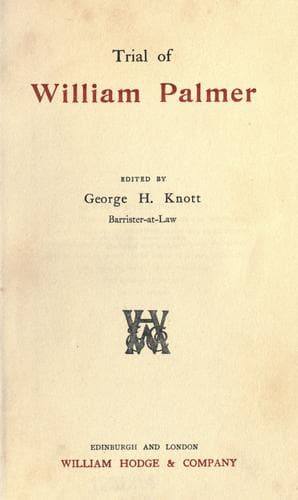
Cook, John Parsons, -1855; Palmer, William, 1824-1856 -- Trials, litigation, etc.; Trials (Murder) -- England -- London
But let us see, before I make any further observations upon that point,
how the matter stands upon the proof which is before us. I told you that
Mr. Palmer was a man in circumstances of the direst embarrassment, with
ruin actually staring him in the face, and that nothing could avert that
ruin save pecuniary means at once obtained for his purpose. The proof
which I have offered to you has fully come up to the proposition with
which I started. The fact has been proved beyond the possibility of
doubt. It appears that in the month of November, 1855, Mr. Palmer was in
this position. He owed upon bills, all of which were forged, the sum of
£19,000; he had bills to the amount of £12,500 standing in the hands of
Mr. Pratt; he had bills to the amount of £6500 standing in the hands of
Mr. Wright; and he had a bill for £2000 in the hands of Mr. Padwick.
Although it is true that £1000 upon that account had been paid off to
Mr. Pratt, yet the bills still remained for the full amount in Mr.
Pratt’s hands. Although £1000 had been paid to Mr. Padwick, he held a
warrant of attorney and a bill of sale upon the stud for the remaining
£1000. All those bills, without exception, were forgeries. A
correspondence took place between Mr. Pratt and himself with regard to
the £13,000 policy upon his brother’s death, through which he hoped to
liquidate Mr. Pratt’s demand; he had been disappointed of that money,
and upon the office declining to pay the money, as early as the middle
of October, Mr. Pratt gave him to understand, in the most distinct and
positive terms, that the bills must be met. Bills for £4000 were due, or
were coming due, at the end of that month--one upon the 25th for £2000,
and another upon the 27th for £2000. Bills already renewed were coming
due from month to month, and there was £5500 which it was necessary
immediately to provide for. Mr. Pratt gave him notice that he could give
him no longer delay, inasmuch as the office had resolved to dispute this
policy. It was no longer an existing valid security, and consequently
Mr. Pratt could not be a party to representing to his clients, with
whose money those bills had been discounted, that it was in any respect
a valid security, therefore the bills must be met.
[Sidenote: Attorney-General]
Public-domain text, read in full here on John Shaqi.
Reviews
Reviews
No reviews yet
Be the first to share your thoughts on this work.
Elsewhere in the archive
Join the Discussion
Join the discussion
Sign in to leave a comment or review.
Sign InorCreate an account