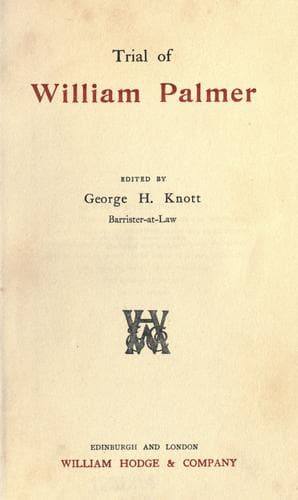
Cook, John Parsons, -1855; Palmer, William, 1824-1856 -- Trials, litigation, etc.; Trials (Murder) -- England -- London
the £300 is not sent up, Palmer keeps it in his pocket; what is done
with the other £200? Is it carried to the account of the matter in which
they had joint interest with Pratt? No such thing; it goes as part of
the payment made by Palmer to Pratt on account of the bills which Pratt
then held--it never went to any matter of joint interest--it is an idle
and false pretence to say that Cook was in any way responsible to Pratt;
it may have been the intention of Palmer when Cook should be no more to
represent him as so, but there is no foundation in reality and in fact
for the statement. I say the transaction of the £500, so far from
helping the prisoner’s case, shows conclusively that the £200 advanced
by Fisher, and the £300 to be sent up that night to satisfy this bill
for £500, and the assignment to release “Polestar” and “Sirius,” was
£500 more taken from this young man and appropriated by the prisoner to
his own use.
[Sidenote: Attorney-General]
But the matter does not rest there--would it did. I come now to the
transaction of the Monday, and I find £1020 of Cook’s money applied to
the prisoner’s use. He goes up to London; he had ascertained by some
means or other the amount that Cook was entitled to receive on the
Monday--possibly Cook had told him; Fisher was Cook’s agent, and the
probability is that Cook desired the prisoner to hand an account of his
bets which he had won to Fisher, who would go and settle with the
parties at Tattersall’s; Fisher would have to pay himself back the £200;
we know that he intended his accounts should pass through Fisher,
because he asked Fisher to advance the £200 upon the credit of it; but
it is suggested that under the guidance of Palmer he now meditated a
fraud, and that he intended to pass his account through Mr. Herring, in
order to avoid paying Fisher the £200 for a time. Is it charitable to
Mr. Cook to ascribe to him a fraud of this description, which, so far as
we know, he was not in the habit of doing? I ask you this question as
reasonable men, supposing he had disposed of his ready money, and we
find none left--that he had given the prisoner £300 to send up, you
cannot suppose that this man who had nothing of his fortune left, who
sees ruin staring him in the face--he was not a ruined man as long as he
had this money, but having parted with this money he was a ruined
man--you cannot suppose that he intended to deprive himself of the whole
of the money that he had won, to leave himself destitute and naked for
the coming winter; the thing is out of the question--besides, if the
prisoner’s representation is true which he made to Mr. Cheshire, that he
had got the genuine cheque of this man for very nearly the amount,
through his agents, Messrs. Wetherby, of the stakes at Shrewsbury, you
are asked to believe on the one hand that he had given him his ready
money, and on the other hand that he had given him a cheque to receive
of Messrs. Wetherby, and that he had given him £1020, which constituted
Public-domain text, read in full here on John Shaqi.
Reviews
Reviews
No reviews yet
Be the first to share your thoughts on this work.
Elsewhere in the archive
Join the Discussion
Join the discussion
Sign in to leave a comment or review.
Sign InorCreate an account