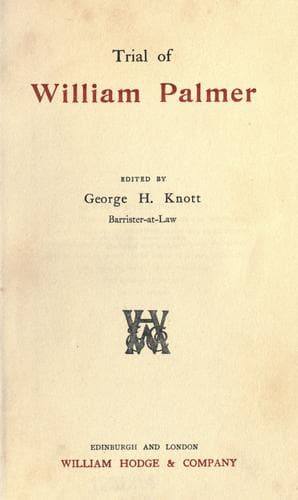
Cook, John Parsons, -1855; Palmer, William, 1824-1856 -- Trials, litigation, etc.; Trials (Murder) -- England -- London
But it does not stop even there; the inquiry takes place, and the
post-mortem examination having been made, a coroner’s inquest is
insisted upon and becomes inevitable, and then we have the prisoner
seeking to tamper with the administration of a most important office;
sending presents to the coroner at the time the inquest was sitting;
presents, unquestionably, of game and things of that description, and if
the evidence does not very much mislead us a present of money also. For
what purpose was all that done? We find him, with uneasy restlessness,
obtaining through Cheshire information of what is taking place between
the professional man who was employed to analyse the contents of the
stomach and the attorney at Rugeley who was instructed on behalf of Mr.
Stevens; is that the conduct of innocence or of guilt? Why should he be
desirous of knowing whether strychnia, above all other things, should be
found in the intestines of the deceased? Let me call your attention to
the letter which he writes to the coroner--“I am sorry to tell you that
I am still confined to my bed; I do not think it was mentioned at the
inquest yesterday that Cook was taken ill on Sunday and on Monday night
in the same way that he was on Tuesday night when he died; the
chambermaid at the Crown Hotel can prove this; I believe a man of the
name of Fisher is coming down to prove that he received some money at
Shrewsbury; now, here he can only pay Smith £10 out of £41 he owed him.
“Does he tell what had become of the rest of the money that the man had
at Shrewsbury? “Had you not better call Smith,” that is, Mr. Jeremiah
Smith whom we saw here to-day, “to prove this?” What a witness Jeremiah
Smith would have been in the hands of the coroner, Mr. Ward, the
friendly coroner of Staffordshire! And, again, “Whatever Professor
Taylor may say to-morrow, he wrote from London last Tuesday night to
Gardner to say, we (that is, Dr. Taylor and Dr. Rees) have this day
finished our analysis, and find no traces of either strychnia, prussic
acid, or opium; what can beat this from a man like Taylor, if he says
what he has already said of Dr. Harland’s evidence? Mind you, I know it,
I saw in black and white what Taylor said to Gardner; but this is
strictly private and confidential, but it is true. As regards his
betting book, I know nothing of it, and it is of no good to any one”;
the repetition of the same story. “I hope the verdict to-morrow will be
that he died of natural causes, and thus end it”; but the verdict was
not so, and it did not end it; and it is for you to say whether upon a
review of the whole of this evidence you can come to any other
conclusion than that of the prisoner’s guilt. Look at his restless
anxiety; it may possibly, it is true, be compatible with innocence, but
I think on the other hand it must be admitted that it bears strongly the
aspect of guilt; if it stood alone, I would not ask you upon that to
Public-domain text, read in full here on John Shaqi.
Reviews
Reviews
No reviews yet
Be the first to share your thoughts on this work.
Elsewhere in the archive
Join the Discussion
Join the discussion
Sign in to leave a comment or review.
Sign InorCreate an account