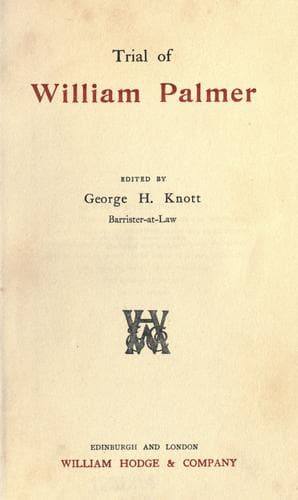
Cook, John Parsons, -1855; Palmer, William, 1824-1856 -- Trials, litigation, etc.; Trials (Murder) -- England -- London
The next witness is a witness worthy of all praise for the sincerity
which he exhibited. I mean Dr. Wrightson. Now, gentlemen, this witness,
who, I have no doubt, is a most scientific and a very honourable man,
speaks as a man of science, and, according to him, the poison would be
found in the body; but he speaks with proper caution, and upon his
evidence you ought to say whether, under particular circumstances, it
might not be discoverable, or whether the person seeking for it might
fail to employ the proper means for detecting it in the body.
Then comes Mr. Partridge, a most respectable gentleman, who says he has
been many years in practice as a surgeon, and is professor of anatomy at
King’s College. Now, gentlemen, you have here the opinion of a very
respectable witness as to the different topics that he touches upon; and
the most important one is that he thinks that the symptoms that were
exhibited did not correspond with what he should expect from strychnia;
but he speaks from his own experience, and you have it from the other
witnesses that the symptoms vary considerably in different cases.
The next witness is Mr. John Gay. Now, gentlemen, this was a case, you
see, of tetanus arising from the toe being smashed; and it seems to me,
although, of course, you will form your own opinion upon it, bears no
analogy whatever to the case of Cook, with regard to whom no such cause
could be assigned. Again, gentlemen, he says, what is very material,
that, in the event of a given state of tetanus, it would be extremely
difficult, if not impossible, without collateral evidence, to ascribe
the tetanic disease to any cause in the absence of any evidence as to
the cause. But you will form your own opinion upon it. Therefore you are
to look to collateral evidence; and if the collateral evidence would
impute the symptoms of tetanic convulsions to any particular cause,
according to this witness that cause may be assigned. That I say with a
view to get what is called the moral evidence with regard to the conduct
of a particular person, and with regard to what he may have done or what
he may have had in his possession.
[Sidenote: Lord Campbell]
Now comes Dr. M‘Donald. You will observe that he gives an account of
experiments he made for the prisoner, and you will see the lengths to
which he goes in adopting a new form of disease of epilepsy with these
complications. You are to say what weight you give to that evidence
compared with the witnesses who have given evidence before you.
The next witness is Mr. John Bainbridge. The object of this witness’s
evidence seems to be to induce you to believe that this was a case of
epilepsy, and from the symptoms you will say whether you can come to
that conclusion.
The next witness is Mr. Edward Steady. The case referred to by this
witness seems to be a case of traumatic tetanus; and you will say, if it
were idiopathic, whether the course of it in the slightest degree
resembles the symptoms of Cook, the deceased.
Public-domain text, read in full here on John Shaqi.
Reviews
Reviews
No reviews yet
Be the first to share your thoughts on this work.
Elsewhere in the archive
Join the Discussion
Join the discussion
Sign in to leave a comment or review.
Sign InorCreate an account