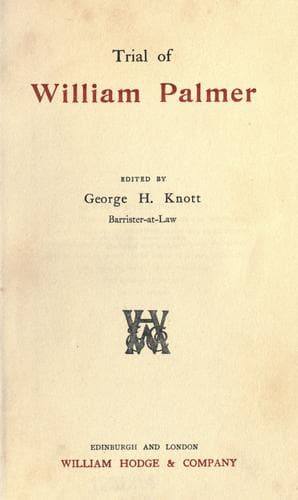
Cook, John Parsons, -1855; Palmer, William, 1824-1856 -- Trials, litigation, etc.; Trials (Murder) -- England -- London
Where death has taken place from strychnia I should not expect to find
it where the quantity taken is small, but where there is a considerable
excess over the quantity necessary to destroy life by absorption I
should expect to find it. Colouring tests are, I think, uncertain in
some respects. Vegetable poisons are generally more difficult to detect.
There is one I know for which there is no test I know of. The stomach
that was sent to Dr. Taylor to operate upon, from the description that
he gave of it to-day, was in a very unsatisfactory condition. If I had
been called upon to analyse such a stomach, I should not have
entertained any reasonable expectation of doing any good with it if I
had not been informed that there was a considerable quantity of
strychnia present. I have no doubt, from the evidence I have heard as to
the Leeds case, the Glasgow case, and the Romsey case, that they were
deaths from strychnia. The symptoms in these cases appear to me very
similar to those of Mr. Cook.
[Sidenote: R. Christison]
Cross-examined by Mr. GROVE--From my own observation, I should say that
animals who die from strychnia die of suffocation--asphyxia; but in
another part of my book which is referred to, I leave the question open.
By asphyxia I mean stopping of the respiration.
Where is it in your book?--It is under the head of nux vomica, at the
bottom of page 898.
I do not find that meets the case?--It leaves the question open; it
takes place through an influence on the heart sometimes, and through an
influence on the respiration; it is now more open, particularly from the
cases which have occurred of death from strychnia.
In the animals poisoned by strychnia that you examined was there blood
in the right cavity?--Yes, in both.
You state in your book, and you tell me that when death does not take
place suddenly in a fit of spasms, the person continues to be affected
for twelve or fourteen hours, with small or milder paroxysms. Is that a
statement which, according to your subsequent knowledge, is correct?--I
have known the effects cease in a shorter time.
You state on page 903, after mentioning a case where the body was rigid,
“the state of rigidity, however, does not invariably occur; on the
contrary, in animals the limbs become very flaccid immediately after
death, but the usual rigidity supervenes at an early period.” I presume
the rigidity of which you speak is the rigidity of death,
rigor-mortis?--Yes.
Public-domain text, read in full here on John Shaqi.
Reviews
Reviews
No reviews yet
Be the first to share your thoughts on this work.
Elsewhere in the archive
Join the Discussion
Join the discussion
Sign in to leave a comment or review.
Sign InorCreate an account