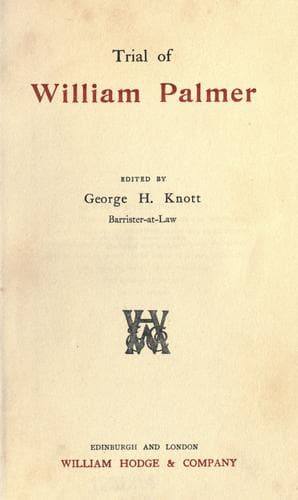
Cook, John Parsons, -1855; Palmer, William, 1824-1856 -- Trials, litigation, etc.; Trials (Murder) -- England -- London
Having said so much I will now apply myself to what, in my judgment, is
an equally important, if not more important, question in this case, one
which I approach with no diffidence whatever except the distrust which I
have, under the circumstances in which I speak, of myself, and which, if
it were possible for me to write what I think upon it and then to read
it to you, I do not entertain the smallest doubt that you must be
convinced of the innocence of this man--the question whether, in the
second week of November, 1855, he had a motive for the commission of
this murder, some strong reason for desiring that Cook should die. I
never will believe that, unless it be made clear to you that it was the
interest of William Palmer, or that he thought it was his interest, to
destroy Cook--I never will believe, till I hear your verdict pronounced,
that a jury can come to the conclusion of his guilt. And it seems to me,
upon the evidence which has been laid before you, abundantly clear that
it not only was not the interest of William Palmer that Cook should die,
but that his death was the very worst calamity that could befall him,
and that he could not possibly be ignorant that it must be immediately
followed by his own ruin. That it was followed by his immediate ruin we
know. We know that at the time when he is said to have commenced to plot
the death of Cook he was in a condition of the greatest embarrassment.
It was an embarrassment which, in its extreme intensity, had come but
recently upon him, an embarrassment, too, in some degree mitigated by
the circumstance that the person upon whom these bills, which have been
stated to you to be forgeries, purported to be drawn was his own mother,
a lady of a very large fortune, and with whom he was on the most
affectionate terms. Still, he was in a condition unquestionably of great
embarrassment. My learned friend has raised the hypothesis of his having
a wish to destroy Cook upon the ground of this embarrassment. My learned
friend stated to you that the case of the Crown against the prisoner was
this, that, “being in desperate circumstances, with ruin, disgrace, and
punishment staring him in the face, he took advantage of his intimacy
with Cook, when Cook had been the winner of a considerable sum of money,
to destroy him and get possession of his money.” That is the theory of
the Crown. Now, let us test it as a matter of business, relieving, if
possible, our minds from the anxiety we must all feel when the fate of a
fellow-creature is at stake, as if it was a case in a private room for
the decision of an arbitrator. It is my misfortune not to be able at
times to speak otherwise than earnestly, but let us look at it as a
matter of business and scrutinise it in every corner. Was it his
interest that in the second week in November, 1855, Mr. Cook should be
killed by a railway accident? If it was not, we have no motive to
ascribe to it. If it was not, and more, if the contrary was clearly his
Public-domain text, read in full here on John Shaqi.
Reviews
Reviews
No reviews yet
Be the first to share your thoughts on this work.
Elsewhere in the archive
Join the Discussion
Join the discussion
Sign in to leave a comment or review.
Sign InorCreate an account