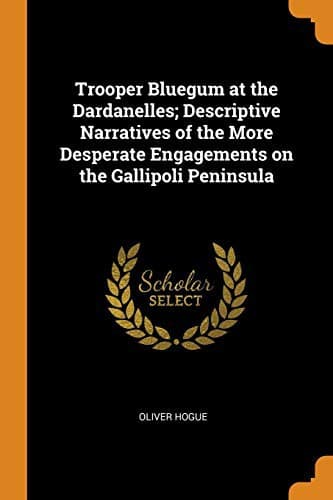
Trooper Bluegum at the Dardanelles: Descriptive Narratives of the More Desperate Engagements on the Gallipoli PeninsulaHogue, Oliver
History
Trooper Bluegum at the Dardanelles: Descriptive Narratives of the More Desperate Engagements on the Gallipoli Peninsula
Hogue, Oliver
World War, 1914-1918 -- Campaigns -- Turkey -- Gallipoli Peninsula; World War, 1914-1918 -- Personal narratives, Australian
We never saw much of him on the _Suevic_; when off duty he used to
climb to some cosy corner on the uppermost deck and read dry textbooks
on strategy and tactics. At odd times he would seek relaxation in
_Life of Napoleon_, _Marlborough_, or _Oliver Cromwell_, but this was
distinctly "not a study, but a recreation." Passing through the Suez
Canal we saw the Turks miles away on the rim of the desert. George
got out his rifle, set the sight at 2,500 yards, and waited. But the
invader kept well out of range, and George went back to his cooking.
It was mid-winter in Egypt and the nights were bitterly cold.
Greatcoats were vitally necessary. How welcome were the mufflers and
Balaclava caps and warm socks knitted by the girls we left behind
us! Welcome also was the hot coffee George provided to fill in the
shivering gap between réveillé and stables. And after the horses had
all been fed and watered, we returned with zest to breakfast--porridge
and meat and "eggs a-cook" and bread and marmalade. I've heard some
grumblers complain of the "tucker" in Egypt, but I've seen a bit of
war by this and I'm convinced that the Australians are the best-fed
army in the world. And George by the same token was not a bad cook.
Summer swooped down on Egypt. In its wake came heat and dust and
flies and locusts. Over the scorching sands of the desert we cantered
till the sweat poured from us and our horses, and the choking dust
enveloped all. "Gyppie" fruit-sellers scurried hither and yon yelling
"Oringes--gooud beeg one." And as we regaled ourselves with the
luscious thirst-quenchers we thought of camp and the dinner that
George was preparing. We trekked along the Nile, and almost before we
halted George was boiling the billy. We bivouacked at Aaron's Gorge,
or the Petrified Forest, or in a desert waste, and always George was
on the spot with his dixies and pans. The cook's cart was a pleasing
silhouette against the pyramid-pierced skyline, when we turned our eyes
westward in the long summer evenings.
When at last we started for the Dardanelles, we of the Light Horse
Brigade had (as you know) to leave our horses behind, and the cook's
cart stopped too. But George came along all right. Despite the
activities of the submarines we reached Gallipoli in safety, and
witnessed the allied warships pounding away at the Turkish defences.
Historic Troy was on our right; before us the entrance to the
Dardanelles; and on the left, firmly established on Helles, was the
great Mediterranean Expeditionary Force, making its first halt on
the road to Constantinople. But we had to go further north, a mile
beyond Gaba Tepe, where the Australians--particularly the 3rd Infantry
Brigade--had performed such deeds of valour that Dargai, Colenso, and
Magersfontein were declared by old soldiers to have been a mere picnic
in contrast.
Public-domain text, read in full here on John Shaqi.
Reviews
Reviews
No reviews yet
Be the first to share your thoughts on this work.
Join the Discussion
Join the discussion
Sign in to leave a comment or review.
Sign InorCreate an account