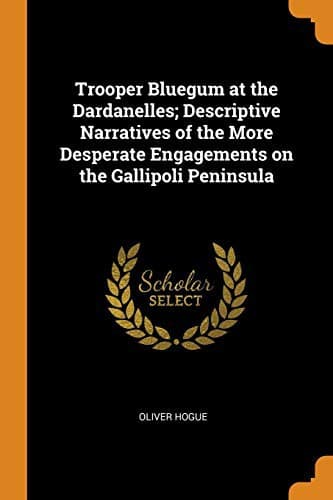
Trooper Bluegum at the Dardanelles: Descriptive Narratives of the More Desperate Engagements on the Gallipoli PeninsulaHogue, Oliver
History
Trooper Bluegum at the Dardanelles: Descriptive Narratives of the More Desperate Engagements on the Gallipoli Peninsula
Hogue, Oliver
World War, 1914-1918 -- Campaigns -- Turkey -- Gallipoli Peninsula; World War, 1914-1918 -- Personal narratives, Australian
We landed amid a hail of shrapnel. Transhipping from the transports,
we crowded into launches and sweepers and barges. These little boats,
heavily laden with khaki freight, made straight for Anzac Cove. Fair
targets for Tommy Turk, of course; so the guns of the Olive Grove
Battery sent us anything but peaceful messages. Plug-plong went the
shells into the water. Zip-zip hissed the bullets all round us. But,
marvellous to relate, not a man was hit. Next day some infantry
reinforcements, landing in the same place and manner, sustained forty
casualties. That's the luck of the game--the fortune of war. We landed
everything satisfactorily.
George brought up the rear, with his pots and dixies. It is because of
George that I recapitulate.
In a long, straggling khaki line ("Column o' lumps," said the brigade
major) we meandered past Casualty Point and Hell Spit, and up to our
bivouac in Shrapnel Valley. Snipers on the hill up beyond Quinn's Post
sent long-range shots at random down the track. Shells burst over our
heads, and the leaden pellets spattered over the landscape. It would
take too long to recount half the miraculous escapes some of our chaps
had. Our artillery worked overtime, and the row was deafening. But
our gunners could not silence the elusive cannon in the Olive Grove.
After a time, wherein the minutes seemed like hours, we reached the
camp site, and started to dig in feverishly. We burrowed like rabbits.
Picks, shovels and bayonets made the earth fly till we had scratched a
precarious shelter from the blast. Like troglodytes we snuggled into
the dug-outs, waiting for the bombardment to cease.
But George went on with his cooking.
[Illustration: Major-General W. T. Bridges.]
Next day we changed our quarters. The German artillerymen were too
attentive. We had sustained a few casualties, so we sought a more
retired spot under the lee of the hill. For the first time since we
had landed we were able to look about us. There was a lull in the
cannonade, though the musketry fusillade proceeded merrily. We saw the
long line of Australian and New Zealand trenches whence the Turks had
been driven in rout the night before, leaving 3,000 dead to mar the
landscape. We heard too, definitely, for the first time of the good
Australians who on this inhospitable shore had given their lives for
King and Empire--General Bridges, Colonel MacLaurin, Lieutenant-Colonel
Braund, Lieutenant-Colonel Onslow Thompson, Sergeant Larkin (who used
to sit on the opposite side to Colonel Braund in the New South Wales
Parliament, but found in war the leveller that makes us all one party),
and hundreds of others. Looking up to the precipitous cliffs above, we
marvelled anew at the reckless daring of our infantry comrades who had
scaled those heights in the face of rifle, machine-gun and shrapnel.
Public-domain text, read in full here on John Shaqi.
Reviews
Reviews
No reviews yet
Be the first to share your thoughts on this work.
Join the Discussion
Join the discussion
Sign in to leave a comment or review.
Sign InorCreate an account