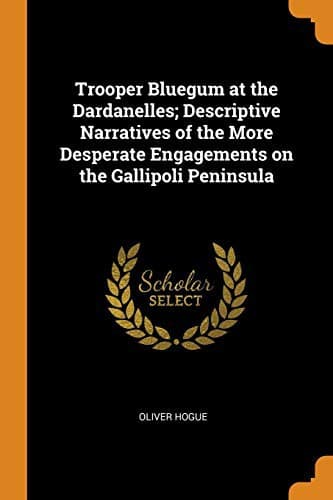
Trooper Bluegum at the Dardanelles: Descriptive Narratives of the More Desperate Engagements on the Gallipoli PeninsulaHogue, Oliver
History
Trooper Bluegum at the Dardanelles: Descriptive Narratives of the More Desperate Engagements on the Gallipoli Peninsula
Hogue, Oliver
World War, 1914-1918 -- Campaigns -- Turkey -- Gallipoli Peninsula; World War, 1914-1918 -- Personal narratives, Australian
After watching the airmen operating over the Suez Canal and the
Mediterranean, and in Gallipoli, we came to the conclusion that flying
is easily the safest job in war time. We used to think otherwise. To
the onlooker it appeared so hazardous, that the marvel was that those
dare-devils were not all blown to smithereens. But for about three
months, we watched them at work, and not a hair of one of their heads
was harmed. Time and again the airman sailed across the enemy's lines,
while their anti-aircraft guns worked overtime. The blue of the sky
was flecked with white puffs of smoke where the shells burst, yet the
aeroplane flew on serenely. I counted forty-one shells one day, which
burst all round one of our airmen on reconnaissance. Many seemed to go
very close indeed; others flew wide of the mark. The Turkish trenches
would spring to life as our 'planes passed over, and thousands of
rounds would be poured into the atmosphere. Their machine-guns would
sound the rataplan as the belts were emptied. But the wild fusillade
never disconcerted the airmen. All of which proves what an exceedingly
difficult target the aeroplane must be.
We did not have any Zeppelins buzzing round the Dardanelles. Perhaps
they were too busily engaged on their baby-killing enterprises on the
east coast of old England. The nearest thing we had was an observation
balloon, looking for all the world like a huge German sausage suspended
in mid-air. But it was very helpful to our warships for observation
purposes.
CHAPTER XVII
"PADRE"
BERGIN--ROBERTSON--MILLER--GOOD AND BRAVE CHRISTIAN DIVINES--TURKISH
IMAMS--A CHESS-PLAYING CLERIC--POCKET TESTAMENTS AND SUNDAY
SERVICES--HILL-SIDE WORSHIP--HYMNS AND THE CANNONS' ROAR
In the training camps in Australia the chaplains conducted services,
helped at the concerts, and generally made themselves useful and
agreeable. On the transports they did pretty much the same thing; but
somehow we never seemed to know them, and they, in turn, knew very few
of us by name. It was when we settled down in Egypt that we first began
to know them, and to appreciate their work. And since Cairo has the
reputation of being the wickedest city in the world, there was ample
scope for the operations of the chaplains.
But one of the chaplains had adamantine ideas on theological subjects.
He was a great scholar, and had other virtues, but his conscience
would not let him participate in the combined services with the other
ministers. So when we came away to thrash the Turk we left him behind
in Egypt.
Public-domain text, read in full here on John Shaqi.
Reviews
Reviews
No reviews yet
Be the first to share your thoughts on this work.
Elsewhere in the archive
Join the Discussion
Join the discussion
Sign in to leave a comment or review.
Sign InorCreate an account