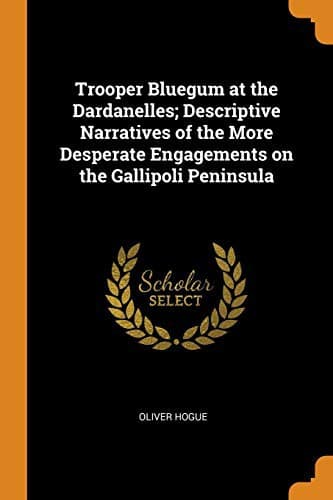
Trooper Bluegum at the Dardanelles: Descriptive Narratives of the More Desperate Engagements on the Gallipoli PeninsulaHogue, Oliver
History
Trooper Bluegum at the Dardanelles: Descriptive Narratives of the More Desperate Engagements on the Gallipoli Peninsula
Hogue, Oliver
World War, 1914-1918 -- Campaigns -- Turkey -- Gallipoli Peninsula; World War, 1914-1918 -- Personal narratives, Australian
Now, it is pleasing to record that no such order was necessary in the
ranks of the Australian division. Our chaplains since the memorable day
of the landing played their part manfully in the great game. McKenzie
of the Salvation Army was real grit; one of the finest of our militant
Churchmen. They were in the trenches day and night, talking with the
men, writing letters home to their people, visiting the sick; and every
man in our brigade was supplied with a neat little pocket Testament
by a friend of the New South Wales Auxiliary of the British and
Foreign Bible Society. And on Sundays there were services in all the
brigades--in the gullies, or under the crests of the hills behind the
firing line. And sometimes we couldn't hear the singing because of the
cannons' roar; there was not one solitary spot in Anzac absolutely safe
from the enemy's fire. And yet I have never heard of any soldier being
wounded at any of these services! Once Padre Miller was conducting a
service in Shrapnel Valley, and had finished his firstly, secondly, and
thirdly, and was just coming to the peroration, when shrapnel shells
burst overhead. So the service had to be abandoned. That was a "sair"
trial to the "Meenister."
Yet, in spite of his many estimable qualities, I regret to state that
Padre Miller had one besetting sin. It was a secret sin. Only a few of
us knew of his weakness. He played chess. Yes, played chess over and
over and over again. When in Cairo others of us would play tennis, he
would slink away with some old crony and play chess. I have known him
play till two o'clock in the morning at a game. (There is no doubt
about the hour, because he called for me on the way back to camp.) He
was often late at mess, playing chess. He scarce had time to dress,
playing chess. Admittedly he played well, and after defeating the
Ma'adi champions he sought fresh victims in Cairo. The Scotch engineer
on the transport was a fine player, but he couldn't checkmate the padre.
When we landed in Gallipoli the first thing the padre did was to dig a
dug-out. The second was to seek a chess-mate. There was no chessboard,
so he got the lid of a box. There were no chessmen, so he carved
Queens and Bishops and Knights and Pawns out of the flotsam and jetsam
on Anzac Beach. Then, safely ensconced in a snug little dug-out, the
padre and his mate stalemated and checkmated to their hearts' content,
oblivious of the shells which burst around. Immediately after his tour
of the trenches, and his visit to the sick, the padre would make for
his chess-mate.
Later on we found him making periodical visits to the hospital ship. I
admit he religiously did the rounds of the wards, and looked after the
wounded, and I frankly admit that I went on board to see the nurses,
but I'm positive the driving force behind the padre's visits was the
prospect of a game of chess with the skipper.
Public-domain text, read in full here on John Shaqi.
Reviews
Reviews
No reviews yet
Be the first to share your thoughts on this work.
Elsewhere in the archive
Join the Discussion
Join the discussion
Sign in to leave a comment or review.
Sign InorCreate an account