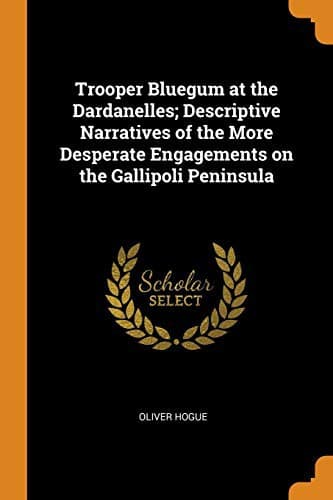
Trooper Bluegum at the Dardanelles: Descriptive Narratives of the More Desperate Engagements on the Gallipoli PeninsulaHogue, Oliver
History
Trooper Bluegum at the Dardanelles: Descriptive Narratives of the More Desperate Engagements on the Gallipoli Peninsula
Hogue, Oliver
World War, 1914-1918 -- Campaigns -- Turkey -- Gallipoli Peninsula; World War, 1914-1918 -- Personal narratives, Australian
The pity of it all was that none of his friends knew he had arrived.
The Dean of Sydney--Chaplain-Colonel Talbot--was about to read the
burial service over eighteen soldiers who had perished in the charge.
He heard the name, and looked and saw his friend. That was the first he
knew of Lieutenant La Touche's arrival on Gallipoli--his arrival and
departure.
When we of the Sixth Light Horse first went into camp at Rosebery
Park, La Touche was there with the Thirteenth Battalion, under Colonel
Burnage, one of the most popular, as he afterwards proved one of the
most gallant, officers who ever donned a uniform. Dr. Digges La Touche
desired first to go as a chaplain, but was not selected. Far be it from
me to reflect on the judgment of the Archbishop of Perth who selected
the Anglican chaplains, but I have seen chaplains with not one tithe of
the qualifications that La Touche had for the job. Failing selection as
a chaplain, he enlisted as a private in the First Contingent. But he
was not over-robust and was transferred to the Second Contingent, and
rose to be a colour-sergeant in the Thirteenth. The Primate objected
to ministers serving as soldiers, and the friends of Digges La Touche
time and again urged him to remain behind. But his determination was
fixed, and though health considerations compelled his withdrawal from
the Thirteenth Battalion he attended an officers' training school and
gained a commission as second lieutenant; and he left Sydney in June
with the Sixth Reinforcements of the Second Battalion. Then, after a
brief spell in Egypt, he came to Gallipoli.
Before he got his commission La Touche was a great recruiting sergeant.
He never left in the minds of his hearers any doubts as to his opinion
of Prussian militarism and savagery. His addresses on the war were
fiery orations, inspiring men to patriotic self-sacrifice and zeal
for Empire. He summoned all the riches of his intellect to confound,
refute and castigate the nation that had done such scathe to Belgium.
And though no Turk or Hun died by his hand, Dr. La Touche inspired many
young Australians to take their place in the firing-line. Some of these
were with him in the fatal charge. He saw them dash on through the
bursting shrapnel, and he heard the cheers of victory as they gained
the parapets, bayoneted the defenders and captured the position. As
one thinks of him cut off in the prime of life, when the unbalanced
enthusiasm of his youth had hardly been tempered by experience, there
comes a feeling of revolt against the decrees of the God of Battles.
But Everard Digges La Touche was only one of the many brilliant young
men who have laid down their lives in this cruel war. Remembering the
inspiration of his example, one feels that he did not die in vain.
Public-domain text, read in full here on John Shaqi.
Reviews
Reviews
No reviews yet
Be the first to share your thoughts on this work.
Elsewhere in the archive
Join the Discussion
Join the discussion
Sign in to leave a comment or review.
Sign InorCreate an account