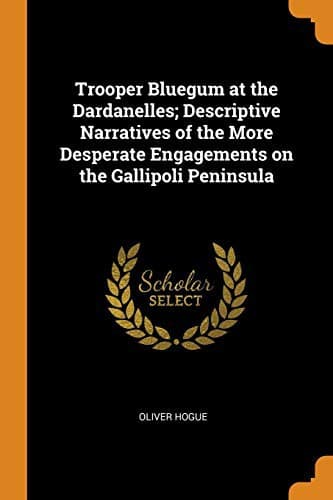
Trooper Bluegum at the Dardanelles: Descriptive Narratives of the More Desperate Engagements on the Gallipoli PeninsulaHogue, Oliver
History
Trooper Bluegum at the Dardanelles: Descriptive Narratives of the More Desperate Engagements on the Gallipoli Peninsula
Hogue, Oliver
World War, 1914-1918 -- Campaigns -- Turkey -- Gallipoli Peninsula; World War, 1914-1918 -- Personal narratives, Australian
There were three sergeants of the 6th Light Horse Regiment, who now
are resting in little shallow graves in Gallipoli. Never again will
they watch the sun go down in splendour into the Ægean Sea. When we go
marching into Berlin they will be with us--but only in spirit; and
when the war is over and the boys from the bush ride home again, there
will be three sergeants missing. But their names will be emblazoned on
Australia's roll of honour. And we of the Sixth won't forget Sergeant
Sid Parkes, Sergeant F. R. Tresilian, and Sergeant Fred Ellis.
Sid Parkes was small and slight, so small that he was almost rejected
by the medical examiner. He had to show his South African record, and
remind the doctor that giants were not wanted in the Light Horse, but
light, active, wiry horsemen. So he just scraped through and went into
camp. I remember him at Rosebery Park. Not much over five feet three,
only about nine stone, but active and strong. He knew his mounted drill
like a book, and he knew how to handle men; so he soon got his three
stripes--and stuck to them. The men liked him. The officers appreciated
him. We saw several other sergeants made and unmade, but Parkes of B
Squadron was a fixture.
Already he had seen four years' peace service, and eighteen months'
active service in South Africa with the New South Wales Mounted
Rifles. So he brought the lessons of his previous experience to bear
on his new job. On parade he did his duty well. Off duty he was a
humorist, and as care-free as a schoolboy. On the transport he entered
into all the fun going. In Egypt he played the game. Somehow, I always
thought Parkes would come safely through the war. We joked together the
night we first went into the trenches, never anticipating ill. Yet he
was the first man of the regiment killed in the trenches. A sniper's
bullet came through a loophole and killed him on the spot.
* * * * *
Frederick George Ellis, sergeant in C Squadron, was an Englishman from
Hants. He had spent five years in the Royal Navy, some of the time on
the China station. He was one of the few survivors of H.M.S. _Tiger_,
which was rammed and sunk during the naval manoeuvres off Spithead.
Three years ago he came to Australia to get colonial experience, prior
to settling on the land. A few years in the nor'-west, at Bogamildi
and Terala stations, transformed the sailor into a bushman. So he came
to Sydney when war broke out, and joined the 6th Light Horse. He rose
to be lance-sergeant. On July 12 he was killed by a shrapnel shell on
Holly Ridge. Several of our fellows were killed and wounded that day,
for the Turks dropped 200 shells on the Light Horse lines, and for an
hour or two it was terrific.
* * * * *
Public-domain text, read in full here on John Shaqi.
Reviews
Reviews
No reviews yet
Be the first to share your thoughts on this work.
Elsewhere in the archive
Join the Discussion
Join the discussion
Sign in to leave a comment or review.
Sign InorCreate an account