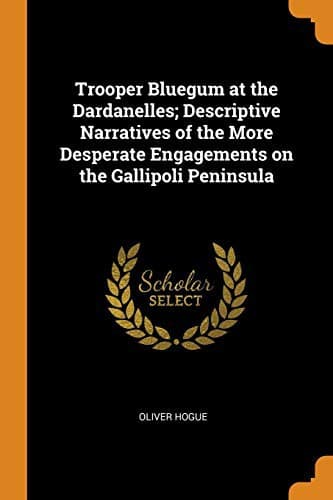
Trooper Bluegum at the Dardanelles: Descriptive Narratives of the More Desperate Engagements on the Gallipoli PeninsulaHogue, Oliver
History
Trooper Bluegum at the Dardanelles: Descriptive Narratives of the More Desperate Engagements on the Gallipoli Peninsula
Hogue, Oliver
World War, 1914-1918 -- Campaigns -- Turkey -- Gallipoli Peninsula; World War, 1914-1918 -- Personal narratives, Australian
Brigadier-General Ryrie, the brigade-major, Major Foster, and the staff
captain, Captain Pollok, were all wounded. Of the fifty New South Wales
officers of the brigade who landed on Gallipoli, the orderly-officer,
Lieutenant Hogue, and the adjutant of the 6th Light Horse, Captain
Somerville, were the only two who had not been killed, wounded or sick.
A great many officers who had been sick and wounded, after a month or
two in hospital returned to duty.
The landing of the 3rd Brigade, and the subsequent terrific three days'
fighting on the heights of Gallipoli by the 1st, 2nd and 3rd Brigades
made Wolfe's exploit on the Heights of Abraham sound like a picnic. The
thrilling capture of Lone Pine by the 1st Brigade was one of the finest
exploits of the war, while the splendid defence of that stronghold by
the 2nd Infantry Brigade and the 2nd Light Horse Brigade against the
repeated counter-attacks of the Turks was worthy of all praise. The
magnificent charge of the 2nd Infantry Brigade down at Helles made
the British and French troops thrill with pride. The charge of the
1st Light Horse Brigade at Walker's Ridge was a glorious sacrifice.
Australians have every reason always to be proud of the first fights of
her First Division.
CHAPTER XXV
SHELL GREEN
THE NEW WARFARE--ALTOGETHER UTILITARIAN--ITS HUMOUR AND PATHOS--THE
LUCK OF THE GAME--GOD'S ACRE--AERIAL WARFARE--GALLANT DEEDS--GENERAL
RYRIE
My dug-out overlooked Shell Green.
From the comparative safety of this retreat I could sit and watch the
pomp and circumstance of war, its pageantry and pathos.
To be sure there was little that was picturesque in war as we saw it in
Gallipoli. There was no martial music. The "thin red line" had given
place to drab khaki. There were no fiery war-horses with tossing manes
and champing bits, no dashing cavalrymen with flashing sabres. There
were no gun teams, spanking bays and blacks, for we had to man-handle
the guns up and down the hills into action. The nearest approach to a
pageant was when the British fleet flew along the Ægean waterway, and
fired some reverberating salvos at the Turkish batteries.
Ashore all was strictly utilitarian; no ceremony, no display. It was
midsummer, so we curtailed our trousers and wore shorts. Our shirts
were sleeveless. Putties and leggings were mostly discarded. When out
of the trenches shirts were usually considered superfluous. Our backs
and arms and legs were so sun-tanned that the brownest of the beach
surfers at Bondi would envy our complexions. So when on fatigues or off
duty it was a tatterdemalion army that marched to and fro over Shell
Green.
Public-domain text, read in full here on John Shaqi.
Reviews
Reviews
No reviews yet
Be the first to share your thoughts on this work.
Elsewhere in the archive
Join the Discussion
Join the discussion
Sign in to leave a comment or review.
Sign InorCreate an account