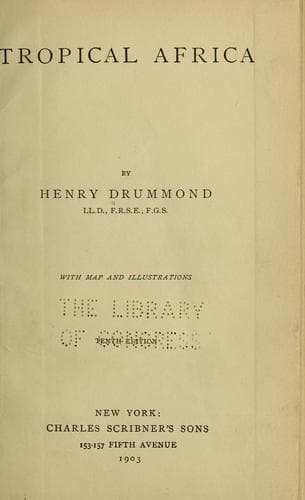
Africa, Central -- Description and travel; Africa, East -- Description and travel; Natural history -- Africa; Slave trade
soldier termite advances to the fight. With a few sweeps of its
scythe-like jaws it clears the ground, and while the attacking party
is carrying off its dead, the builders, unconscious of the fray,
quietly continue their work. To every hundred workers in a white ant
colony, which numbers many thousands of individuals, there are
perhaps two of these fighting men. The division of labor here is
very wonderful, and the fact that besides these two specialized forms
there are in every nest two other kinds of the same insect, the kings
and queens, shows the remarkable height to which civilization in
these communities has attained.
But where is this tunnel going to, and what object have the insects
in view in ascending this lofty tree? Thirty feet from the ground,
across innumerable forks, at the end of a long branch, are a few feet
of dead wood. How the ants know it is there, how they know its sap
has dried up, and that it is now fit for the termites' food, is a
mystery. Possibly they do not know, and are only prospecting on the
chance. The fact that they sometimes make straight for the decaying
limb argues in these instances a kind of definite instinct; but, on
the other hand, the fact that in most cases the whole tree, in every
branch and limb, is covered with termite tunnels, would show perhaps
that they work most commonly on speculation, while the number of
abandoned tunnels, ending on a sound branch in a _cul de sac_, proves
how often they must suffer the usual disappointments of all such
adventurers. The extent to which these insects carry on their
tunnelling is quite incredible until one has seen it in nature with
his own eyes. The tunnels are, perhaps, about the thickness of a
small-sized gas-pipe, but there are junctions here and there of large
dimensions, and occasionally patches of earthwork are found embracing
nearly the whole trunk for some feet. The outside of these tunnels,
which are never quite straight, but wander irregularly along stem and
branch, resembles in texture a coarse sandpaper; and the color,
although this naturally varies with the soil, is usually a reddish
brown. The quantity of earth and mud plastered over a single tree is
often enormous; and when one thinks that it is not only an isolated
specimen here and there that is frescoed in this way, but often the
whole of the trees of a forest, some idea will be formed of the
magnitude of the operations of these insects and the extent of their
influence upon the soil which they are thus ceaselessly transporting
from underneath the ground.
Public-domain text, read in full here on John Shaqi.
Reviews
Reviews
No reviews yet
Be the first to share your thoughts on this work.
Elsewhere in the archive
Join the Discussion
Join the discussion
Sign in to leave a comment or review.
Sign InorCreate an account