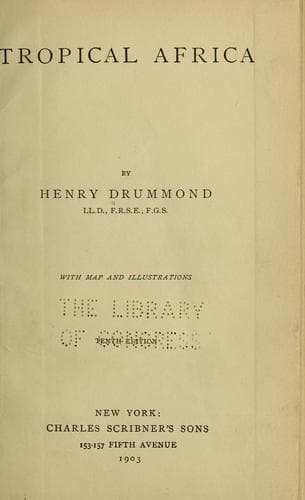
Africa, Central -- Description and travel; Africa, East -- Description and travel; Natural history -- Africa; Slave trade
In travelling through the great forest of the Rocky Mountains or of
the Western States, the broken branches and fallen trunks strewing
the ground breast-high with all sorts of decaying litter frequently
make locomotion impossible. To attempt to ride through these western
forests, with their meshwork of interlocked branches and decaying
trunks, is often out of the question, and one has to dismount and
drag his horse after him as if he were clambering through a woodyard.
But in an African forest not a fallen branch is seen. One is struck
at first at a certain clean look about the great forests of the
interior, a novel and unaccountable cleanness, as if the forest-bed
was carefully swept and dusted daily by unseen elves. And so,
indeed, it is. Scavengers of a hundred kinds remove decaying animal
matter--from the carcase of a fallen elephant to the broken wing of a
gnat--eating it, or carrying it out of sight, and burying it on the
deodorizing earth. And these countless millions of termites perform
a similar function for the vegetable world, making away with all
plants and trees, all stems, twigs, and tissues, the moment the
finger of decay strikes the signal. Constantly in these woods one
comes across what appear to be sticks and branches and bundles of
faggots, but when closely examined they are seen to be mere casts in
mud. From these hollow tubes, which preserve the original form of
the branch down to the minutest knot or fork, the ligneous tissue is
often entirely removed, while others are met with in all stages of
demolition. Examine the section of an actual specimen, which is not
yet completely destroyed, and from which the mode of attack may be
easily seen. The insects start apparently from two centres. One
company attacks the inner bark, which is the favorite morsel, leaving
the coarse outer bark untouched, or more usually replacing it with
grains of earth, atom by atom, as they eat it away. The inner bark
is gnawed off likewise as they go along, but the woody tissue beneath
is allowed to remain to form a protective sheath for the second
company who begin work at the centre. This second contingent eats
its way outward and onward, leaving a thin tube of the outer wood to
the last, as props to the mine, till they have finished the main
excavation. When a fallen trunk lying upon the ground is the object
of attack, the outer cylinder is frequently left quite intact, and it
is only when one tries to drag it off to his camp-fire that he finds
to his disgust that he is dealing with a mere hollow tube a few lines
in thickness filled up with mud.
[Illustration: NESTS OF WHITE ANTS]
But the works above ground represent only a part of the labors of
these slow-moving but most industrious of creatures. The arboreal
tubes are only the prolongation of a much more elaborate system of
subterranean tunnels, which extend over large areas and mine the
earth sometimes to a depth of many feet or even yards.
Public-domain text, read in full here on John Shaqi.
Reviews
Reviews
No reviews yet
Be the first to share your thoughts on this work.
Elsewhere in the archive
Join the Discussion
Join the discussion
Sign in to leave a comment or review.
Sign InorCreate an account