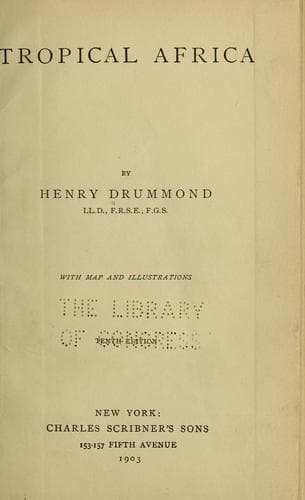
Africa, Central -- Description and travel; Africa, East -- Description and travel; Natural history -- Africa; Slave trade
At the first revelation of all these smart hypocrisies one is
inclined to brand the whole system as cowardly and false. And,
however much the creatures impress you by their cleverness, you never
quite get over the feeling that there is something underhand about
it; something questionable and morally unsound. The evolutionist,
also, is apt to charge mimetic species in general with neglecting the
harmonious development of their physical framework, and by a cheap
and ignoble subterfuge evading the appointed struggle for life. But
is it so? Are the æsthetic elements in nature so far below the
mechanical? Are color and form, quietness and rest, so much less
important than the specialization of single function or excellence in
the arts of war? Is it nothing that, while in some animals the
disguises tend to become more and more perfect, the faculties for
penetrating them, in other animals, must continually increase in
subtlety and power? And, after all, if the least must be said, is it
not better to be a live dog than a dead lion?
VIII.
A GEOLOGICAL SKETCH.
From the work of the various explorers who have penetrated Africa, it
is now certain that the interior of that Continent is occupied by a
vast plateau from 4000 to 5000 feet above the level of the sea. In
five separate regions--in the North-east, in Abyssinia, in the Masai
country, on the Tanganyika plateau, and in the district inland from
Benguela--this plateau attains a height of considerably over 5000
feet; while towards the coast, throughout their entire length, both
east and west, it falls with great uniformity to a lower plateau,
with an elevation of from 1000 to 2000 feet. This lower plateau is
succeeded, also with much uniformity along both coast lines, by
littoral and deltoid plains, with an average breadth from the sea of
about 150 miles.
The section which I am about to describe, entering Africa at the
Zambesi and penetrating inwards to the Tanganyika plateau, traverses
each of these regions in turn--the coast-belt, the lower fringing
table-land, the great general plateau of the country, and the third
or highest elevation of the Tanganyika table-land. To deal
thoroughly with so vast a region in the course of a single
exploration is out of the question; and I only indicate here a few of
the rough results of what was no more than a brief and hasty
reconnaissance.
Public-domain text, read in full here on John Shaqi.
Reviews
Reviews
No reviews yet
Be the first to share your thoughts on this work.
Elsewhere in the archive
Join the Discussion
Join the discussion
Sign in to leave a comment or review.
Sign InorCreate an account