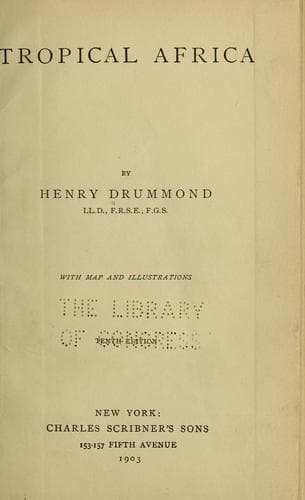
Africa, Central -- Description and travel; Africa, East -- Description and travel; Natural history -- Africa; Slave trade
The connection of Portugal with Africa is an old, and--at least it
was at first--an honorable one. The voyages of the Portuguese were
the first to enrich geography with a knowledge of the African coasts,
and so early as 1497 they took possession of the eastern shore by
founding the colony of Mozambique. This rule, however, though
nominally extending from Delagoa Bay to as far north as Cape Delgado,
was confined to two or three isolated points, and nowhere, except on
the Zambesi, affected more than the mere fringe of land bordering the
Indian Ocean. On the Zambesi the Portuguese established stations at
Senna, Tette, and Zumbo, which were used, though on the most limited
scale, as missionary and trading centres; but these are at present
all but abandoned and in the last stages of decrepitude. The right
of Portugal to the lower regions of the Zambesi, notwithstanding its
entire failure to colonize in and govern the country, can never be
disputed by any European Power, though the Landeens, or Zulus, who
occupy the southern bank, not only refuse to acknowledge the claim,
but exact an annual tribute from the Portuguese for their occupation
of the district.
No one has ever attempted to define how far inland the Portuguese
claim, founded on coast-possession, is to be considered good; but
that it cannot include the regions north of the Zambesi--the Shiré
Highlands and Lake Nyassa--is self-evident. These regions were
discovered and explored by Livingstone. They have been occupied
since his time exclusively by British subjects, and colonized
exclusively with British capital. The claim of England,
therefore--though nothing but a moral claim has ever been made--is
founded on the double right of discovery and occupation; and if it
were a question of treaty with the natives, it might possibly be
found on private inquiry that a precaution so obvious had not been
forgotten by those most nearly interested. On the other hand, no
treaties exist with Portugal; there is not a single Portuguese in the
country, and until the other day no Portuguese had even seen it. The
Portuguese boundary-line has always stopped at the confluence with
the Shiré of the river Ruo, and the political barrier erected there
by Chipitula and the river Chiefs has been maintained so rigidly that
no subject of Portugal was ever allowed to pass it from the south.
Instead, therefore, of possessing the Shiré Highlands, that is the
region of all others from which the Portuguese have been most
carefully excluded.
Public-domain text, read in full here on John Shaqi.
Reviews
Reviews
No reviews yet
Be the first to share your thoughts on this work.
Elsewhere in the archive
Join the Discussion
Join the discussion
Sign in to leave a comment or review.
Sign InorCreate an account