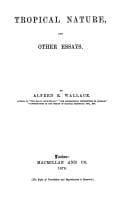
Tropical nature, and other essaysWallace, Alfred Russel
History
Tropical nature, and other essays
Wallace, Alfred Russel
Ecology -- Tropics; Natural history -- Tropics; Tropics
Among naturalists, colour was long thought to be of little import,
and to be quite untrustworthy as a specific character. The numerous
cases of variability of colour led to this view. The occurrence
of white blackbirds, white peacocks, and black leopards; of white
blue-bells, and of white, blue, or pink milkworts, led to the belief
that colour was essentially unstable, that it could therefore be of
little or no importance, and belonged to quite a different class of
characters from form or structure. But it now begins to be perceived
that these cases, though tolerably numerous, are, after all,
exceptional; and that colour, as a rule, is a constant character.
The great majority of species, both of animals and plants, are
each distinguished by peculiar tints which vary very little, while
the minutest markings are often constant in thousands or millions
of individuals. All our field buttercups are invariably yellow, and
our poppies red; while many of our butterflies and birds resemble
each other in every spot and streak of colour through thousands of
individuals. We also find that colour is constant in whole genera and
other groups of species. The Genistas are all yellow, the Erythrinas
all red; many genera of Carabidæ are entirely black; whole families
of birds--as the Dendrocolaptidæ--are brown; while among butterflies
the numerous species of Lycæna are all more or less blue, those of
Pontia white, and those of Callidryas yellow. An extensive survey of
the organic world thus leads us to the conclusion that colour is by
no means so unimportant or inconstant a character as at first sight
it appears to be; and the more we examine it the more convinced we
shall become that it must serve some purpose in nature, and that,
besides charming us by its diversity and beauty, it must be well
worthy of our attentive study, and have many secrets to unfold to
us.
_Theory of Heat and Light as producing Colour._--In commencing our
study of the great mass of facts relating to the colours of the
organic world, it will be necessary to consider first, how far the
chief theories already proposed will account for them. One of the
most obvious and most popular of these theories, and one which is
still held, in part at least, by many eminent naturalists, is--that
colour is due to some direct action of the heat and light of the
sun--thus at once accounting for the great number of brilliant
birds, insects, and flowers, which are found between the tropics.
Public-domain text, read in full here on John Shaqi.
Reviews
Reviews
No reviews yet
Be the first to share your thoughts on this work.
Elsewhere in the archive
Join the Discussion
Join the discussion
Sign in to leave a comment or review.
Sign InorCreate an account