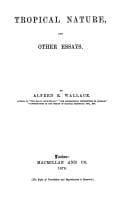
Tropical nature, and other essaysWallace, Alfred Russel
History
Tropical nature, and other essays
Wallace, Alfred Russel
Ecology -- Tropics; Natural history -- Tropics; Tropics
we may say, that amid the constant variations of animals and plants
colour is ever tending to vary and to appear where it is absent;
and that natural selection is constantly eliminating such tints as
are injurious to the species, or preserving and intensifying such
as are useful.
This view is in accordance with the well-known fact, of colours
which rarely or never appear in the species in a state of nature,
continually occurring among domesticated animals and cultivated
plants; showing us that the capacity to develop colour is ever
present, so that almost any required tint can be produced which may,
under changed conditions, be useful, in however small a degree.
Let us now see how these principles will enable us to understand
and explain the varied phenomena of colour in nature, taking them
in the order of our functional classification of colours.
_Theory of Protective Colours._--We have seen that obscure or
protective tints in their infinitely varied degrees are present in
every part of the animal kingdom, whole families or genera being
often thus coloured. Now the various brown, earthy, ashy, and
other neutral tints are those which would be most readily produced,
because they are due to an irregular mixture of many kinds of rays;
while pure tints require either rays of one kind only, or definite
mixtures in proper proportions of two or more kinds of rays. This
is well exemplified by the comparative difficulty of producing
definite pure tints by the mixture of two or more pigments; while
a haphazard mixture of a number of these will be almost sure to
produce browns, olives, or other neutral or dingy colours. An
indefinite or irregular absorption of some rays and reflection of
others would, therefore, produce obscure tints; while pure and
vivid colours would require a perfectly definite absorption of one
portion of the coloured rays, leaving the remainder to produce the
true complementary colour. This being the case we may expect these
brown tints to occur when the need of protection is very slight or
even when it does not exist at all; always supposing that bright
colours are not in any way useful to the species. But whenever a
pure colour is protective,--as green in tropical forests or white
among arctic snows, there is no difficulty in producing it, by
natural selection acting on the innumerable slight variations of
tint which are ever occurring. Such variations may, as we have seen,
be produced in a great variety of ways; either by chemical changes
in the secretions, or by molecular changes in surface structure;
and may be brought about by change of food, by the photographic
action of light, or by the normal process of generative variation.
Protective colours therefore, however curious and complex they may
be in certain cases, offer no real difficulties.
Public-domain text, read in full here on John Shaqi.
Reviews
Reviews
No reviews yet
Be the first to share your thoughts on this work.
Elsewhere in the archive
Join the Discussion
Join the discussion
Sign in to leave a comment or review.
Sign InorCreate an account