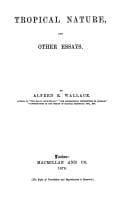
Tropical nature, and other essaysWallace, Alfred Russel
History
Tropical nature, and other essays
Wallace, Alfred Russel
Ecology -- Tropics; Natural history -- Tropics; Tropics
The very frequent superiority of the male bird or insect in
brightness or intensity of colour, even when the general coloration
is the same in both sexes, now seems to me to be, primarily, due
to the greater vigour and activity and the higher vitality of the
male. The colours of an animal usually fade during disease or
weakness, while robust health and vigour adds to their intensity.
This is a most important and suggestive fact, and one that appears
to hold universally. In all quadrupeds a “dull coat” is indicative
of ill-health or low condition; while a glossy coat and sparkling
eye are the invariable accompaniments of health and energy. The
same rule applies to the feathers of birds, whose colours are only
seen in their purity during perfect health; and a similar phenomenon
occurs even among insects, for the bright hues of caterpillars begin
to fade as soon as they become inactive preparatory to undergoing
their transformation. Even in the vegetable kingdom we see the same
thing; for the tints of foliage are deepest, and the colours of
flowers and fruits richest, on those plants which are in the most
healthy and vigorous condition.
This intensity of coloration becomes most developed in the male
during the breeding season, when the vitality is at a maximum. It
is also very general in those cases in which the male is smaller
than the female, as in the hawks and in most butterflies and moths.
The same phenomena occur, though in a less marked degree, among
mammalia. Whenever there is a difference of colour between the sexes
the male is the darker or more strongly marked, and the difference
of intensity is most visible during the breeding season (_Descent
of Man_, p. 533). Numerous cases among domestic animals also
prove, that there is an inherent tendency in the male to special
developments of dermal appendages and colour, quite independently
of sexual or any other form of selection. Thus,--“the hump on the
male zebu cattle of India, the tail of fat-tailed rams, the arched
outline of the forehead in the males of several breeds of sheep,
and the mane, the long hairs on the hind legs, and the dew-lap of
the male of the Berbura goat,”--are all adduced by Mr. Darwin as
instances of characters peculiar to the male, yet not derived from
any parent ancestral form. Among domestic pigeons the character of
the different breeds is often most strongly manifested in the male
birds; the wattles of the carriers and the eye-wattles of the barbs
are largest in the males, and male pouters distend their crops to
a much greater extent than do the females, while the cock fantails
often have a greater number of tail-feathers than the females. There
are also some varieties of pigeons of which the males are striped or
spotted with black while the females are never so spotted (_Animals
and Plants under Domestication_, I. 161); yet in the parent stock
of these pigeons there are no differences between the sexes either
Public-domain text, read in full here on John Shaqi.
Reviews
Reviews
No reviews yet
Be the first to share your thoughts on this work.
Elsewhere in the archive
Join the Discussion
Join the discussion
Sign in to leave a comment or review.
Sign InorCreate an account