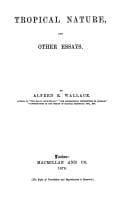
Tropical nature, and other essaysWallace, Alfred Russel
History
Tropical nature, and other essays
Wallace, Alfred Russel
Ecology -- Tropics; Natural history -- Tropics; Tropics
Perhaps the most curious cases of sexual difference of colour are
those in which the female is very much more gaily coloured than
the male. This occurs most strikingly in some species of _Pieris_
in South America, and of _Diadema_ in the Malay islands; and in
both cases the females resemble species of the uneatable Danaidæ
and Heliconidæ, and thus gain a protection. In the case of _Pieris
pyrrha_, _P. malenka_, and _P. lorena_, the males are plain white
and black, while the females are orange, yellow, and black, and so
banded and spotted as exactly to resemble species of Heliconidæ.
Mr. Darwin admits that these bright colours have been acquired
for protection; but as there is no apparent cause for the strict
limitation of the colour to the female, he believes that it has
been kept down in the male by its being _unattractive_ to her. This
appears to me to be a supposition opposed to the whole theory of
sexual selection itself. For this theory is, that minute variations
of colour in the male are _attractive_ to the female, have always
been selected, and that thus the brilliant male colours have been
produced. But in this case he thinks that the female butterfly
had a constant aversion to every trace of colour, even when we
must suppose it was constantly recurring during the successive
variations which resulted in such a marvellous change in herself.
But the case admits of a much more simple interpretation. For if
we consider the fact that the females frequent the forests where
the Heliconidæ abound, while the males fly much in the open and
assemble in great numbers with other white and yellow butterflies
on the banks of rivers; may it not be possible that the appearance
of orange stripes or patches would be as injurious to the male as
it is useful to the female, by making him a more easy mark for
insectivorous birds among his white companions? This seems a more
probable supposition, than the altogether hypothetical choice of
the female, sometimes exercised in favour of and sometimes against
every new variety of colour in her partner.
A strictly analogous case is that of the glow-worm, whose light,
as originally suggested by Mr. Belt, is admitted to be a warning
of its uneatability to insectivorous nocturnal animals. The male,
having wings, does not require this protection. In the tropics
the number of nocturnal insectivorous birds and bats is very much
greater, hence winged species possess the light, as they would
otherwise be eaten by mistake for more savoury insects; and it may
be that the luminous Elateridæ of the tropics really mimic the
true fireflies (Lampyridæ), which are uneatable. This is the more
probable as the Elateridæ, in the great majority of species, have
brown or protective colours, and are therefore certainly palatable
to insectivorous animals.
Public-domain text, read in full here on John Shaqi.
Reviews
Reviews
No reviews yet
Be the first to share your thoughts on this work.
Elsewhere in the archive
Join the Discussion
Join the discussion
Sign in to leave a comment or review.
Sign InorCreate an account