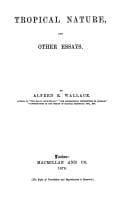
Tropical nature, and other essaysWallace, Alfred Russel
History
Tropical nature, and other essays
Wallace, Alfred Russel
Ecology -- Tropics; Natural history -- Tropics; Tropics
If now we accept the evidence of Mr. Darwin’s most trustworthy
correspondents, that the choice of the female, so far as she exerts
any, falls upon the “most vigorous, defiant, and mettlesome male;”
and if we further believe, what is certainly the case, that these
are as a rule the most brightly coloured and adorned with the finest
developments of plumage, we have a real and not a hypothetical cause
at work. For these most healthy, vigorous, and beautiful males will
have the choice of the finest and most healthy females; will have
the most numerous and healthy families; and will be able best to
protect and rear those families. Natural selection, and what may
be termed male selection, will tend to give them the advantage in
the struggle for existence; and thus the fullest plumage and the
finest colours will be transmitted, and tend to advance in each
succeeding generation.
_Theory of Display of Ornaments by Males._--The full and interesting
account given by Mr. Darwin of the colours and habits of male and
female birds (_Descent of Man_, Chapters xiii. and xiv.), proves
that in most, if not in all cases, the male birds fully display
their ornamental plumage before the females or in rivalry with each
other; but on the essential point of whether the female’s choice
is determined by minute differences in these ornaments or in their
colours, there appears to be an entire absence of evidence. In the
section on “_Preference for particular Males by the Females_,” the
facts quoted show indifference to colour, except that some colour
similar to their own seems to be preferred. But in the case of
the hen canary, who chose a greenfinch in preference to either
chaffinch or goldfinch, gay colours had evidently no preponderating
attraction. There is some evidence adduced that female birds may,
and probably do, choose their mates; but none whatever that the
choice is determined by difference of colour; and no less than three
eminent breeders informed Mr. Darwin that they “did not believe that
the females prefer certain males on account of the beauty of their
plumage.” Again, Mr. Darwin himself says: “As a general rule colour
appears to have little influence on the pairing of pigeons.” The
oft-quoted case of Sir R. Heron’s pea-hens which preferred an “old
pied cock” to those normally coloured, is a very unfortunate one;
because pied birds are just those that are not favoured in a state
of nature, or the breeds of wild animals would become as varied
and mottled as our domestic varieties. If such irregular fancies
were not rare exceptions, the production of definite colours and
patterns by the choice of the female birds, or in any other way,
would be impossible.
Public-domain text, read in full here on John Shaqi.
Reviews
Reviews
No reviews yet
Be the first to share your thoughts on this work.
Elsewhere in the archive
Join the Discussion
Join the discussion
Sign in to leave a comment or review.
Sign InorCreate an account