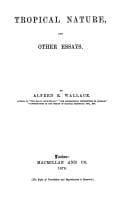
Tropical nature, and other essaysWallace, Alfred Russel
History
Tropical nature, and other essays
Wallace, Alfred Russel
Ecology -- Tropics; Natural history -- Tropics; Tropics
It will perhaps be considered presumptuous to put forth this sketch
of the subject of colour in animals, as a substitute for one of
Mr. Darwin’s most highly elaborated theories--that of voluntary or
perceptive sexual selection; yet I venture to think that it is more
in accordance with the whole of the facts, and with the theory of
natural selection itself; and I would ask such of my readers as may
be sufficiently interested in the subject, to read again Chapters
XI. to XVI. of the _Descent of Man_, and consider the whole subject
from the point of view here laid down. The explanation of almost
all the ornaments and colours of birds and insects as having been
produced by the perceptions and choice of the females, has, I
believe, staggered many evolutionists, but has been provisionally
accepted because it was the only theory that even attempted to
explain the facts. It may perhaps be a relief to some of them, as
it has been to myself, to find that the phenomena can be shown to
depend on the general laws of development, and on the action of
“natural selection,” which theory will, I venture to think, be
relieved from an abnormal excrescence and gain additional vitality,
by the adoption of the views here imperfectly set forth.
Although we have arrived at the conclusion that tropical light and
heat can in no sense be considered as the cause of colour, there
remains to be explained the undoubted fact that all the more intense
and gorgeous tints are manifested by the animal life of the tropics;
while in some groups, such as butterflies and birds, there is a
marked preponderance of highly-coloured species. This is probably
due to a variety of causes, some of which we can indicate, while
others remain to be discovered. The luxuriant vegetation of the
tropics throughout the entire year affords so much concealment, that
colour may there be safely developed to a much greater extent than
in climates where the trees are bare in winter, during which season
the struggle for existence is most severe, and even the slightest
disadvantage may prove fatal. Equally important, probably, has been
the permanence of favourable conditions in the tropics, allowing
certain groups to continue dominant for long periods, and thus to
carry out in one unbroken line whatever developments of plumage or
colour may once have acquired an ascendency. Changes of climatal
conditions, and pre-eminently the glacial epoch, probably led to
the extinction of a host of highly-developed and finely-coloured
insects and birds in temperate zones; just as we know that it led
to the extinction of the larger and more powerful mammalia which
formerly characterised the temperate zone in both hemispheres;
and this view is supported by the fact that it is amongst those
groups only which are now exclusively tropical that all the more
extraordinary developments of ornament and colour are found. The
obscure local causes of colour to which we have referred will
Public-domain text, read in full here on John Shaqi.
Reviews
Reviews
No reviews yet
Be the first to share your thoughts on this work.
Elsewhere in the archive
Join the Discussion
Join the discussion
Sign in to leave a comment or review.
Sign InorCreate an account