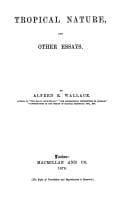
Tropical nature, and other essaysWallace, Alfred Russel
History
Tropical nature, and other essays
Wallace, Alfred Russel
Ecology -- Tropics; Natural history -- Tropics; Tropics
Now just as a surface-geology was required to complete that science,
so a surface-biology was wanted to make the science of living things
more complete and more generally interesting, by applying the results
arrived at by special workers to the interpretation of those external
and prominent features whose endless variety and beauty constitute
the charm which attracts us to the contemplation or to the study of
nature. We have the descriptive zoologist, for example, who gives
us the external characters of animals; the anatomist studies their
internal structure; the histologist makes known the nature of their
component tissues; the embryologist patiently watches the progress
of their development; the systematist groups them into classes and
orders, families, genera, and species; while the field-naturalist
studies for us their food and habits and general economy. But,
till quite recently, none of these earnest students nor all of
them combined, could answer satisfactorily, or even attempted to
answer, many of the simplest questions concerning the external
characters and general relations of animals and plants. Why are
flowers so wonderfully varied in form and colour? what causes the
Arctic fox and the ptarmigan to turn white in winter? why are there
no elephants in America and no deer in Australia? why are closely
allied species rarely found together? why are male animals so
frequently bright-coloured? why are extinct animals so often larger
than those which are now living? what has led to the production of
the gorgeous train of the peacock and of the two kinds of flower
in the primrose? The solution of these and a hundred other problems
of like nature was rarely approached by the old method of study,
or if approached was only the subject of vague speculation. It is
to the illustrious author of the _Origin of Species_ that we are
indebted for teaching us how to study nature as one great, compact,
and beautifully-adjusted system. Under the touch of his magic wand
the countless isolated facts of internal and external structure
of living things--their habits, their colours, their development,
their distribution, their geological history,--all fell into their
approximate places; and although, from the intricacy of the subject
and our very imperfect knowledge of the facts themselves, much still
remains uncertain, yet we can no longer doubt that even the minutest
and most superficial peculiarities of animals and plants either,
on the one hand, are or have been useful to them, or, on the other
hand, have been developed under the influence of general laws, which
we may one day understand to a much greater extent than we do at
present. So great is the alteration effected in our comprehension
of nature by the study of variation, inheritance, cross-breeding,
competition, distribution, protection, and selection--showing, as
they often do, the meaning of the most obscure phenomena and the
mutual dependence of the most widely-separated organisms--that it
Public-domain text, read in full here on John Shaqi.
Reviews
Reviews
No reviews yet
Be the first to share your thoughts on this work.
Elsewhere in the archive
Join the Discussion
Join the discussion
Sign in to leave a comment or review.
Sign InorCreate an account