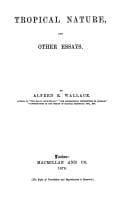
Tropical nature, and other essaysWallace, Alfred Russel
History
Tropical nature, and other essays
Wallace, Alfred Russel
Ecology -- Tropics; Natural history -- Tropics; Tropics
Many now living remember the time (for it is little more than
twenty years ago) when the antiquity of man, as now understood, was
universally discredited. Not only theologians, but even geologists
then taught us, that man belonged altogether to the existing state
of things; that the extinct animals of the Tertiary period had
finally disappeared, and that the earth’s surface had assumed its
present condition before the human race first came into existence.
So prepossessed were even scientific men with this idea--which yet
rested on purely negative evidence, and could not be supported by
any arguments of scientific value--that numerous facts which had
been presented at intervals for half a century, all tending to prove
the existence of man at very remote epochs, were silently ignored;
and, more than this, the detailed statements of three distinct and
careful observers confirming each other, were rejected by a great
scientific Society as too improbable for publication, only because
they proved (if they were true) the coexistence of man with extinct
animals.[54]
[54] In 1854 (?) a communication from the Torquay Natural-History
Society confirming previous accounts by Mr. Godwin-Austen, Mr.
Vivian, and the Rev. Mr. M‘Enery, that worked flints occurred in
Kent’s Hole with remains of extinct species, was rejected as too
improbable for publication.
But this state of belief in opposition to facts, could not long
continue. In 1859 a few of our most eminent geologists examined for
themselves into the alleged occurrence of flint implements in the
gravels of the north of France, which had been made public fourteen
years before, and found them strictly correct. The caverns of
Devonshire were about the same time carefully examined by equally
eminent observers, and were found fully to bear out the statements
of those who had published their results eighteen years before.
Flint implements began to be found in all suitable localities in
the south of England, when carefully searched for, often in gravels
of equal antiquity with those of France. Caverns giving evidence
of human occupation at various remote periods were explored in
Belgium and the south of France--lake-dwellings were examined in
Switzerland--refuse-heaps in Denmark--and thus a whole series of
remains have been discovered carrying back the history of mankind
from the earliest historic periods to a long distant past.
Public-domain text, read in full here on John Shaqi.
Reviews
Reviews
No reviews yet
Be the first to share your thoughts on this work.
Elsewhere in the archive
Join the Discussion
Join the discussion
Sign in to leave a comment or review.
Sign InorCreate an account