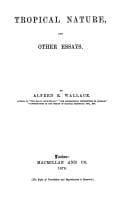
Tropical nature, and other essaysWallace, Alfred Russel
History
Tropical nature, and other essays
Wallace, Alfred Russel
Ecology -- Tropics; Natural history -- Tropics; Tropics
The animal mounds are of comparatively less importance for our
present purpose, as they imply a somewhat lower grade of advancement;
but the sepulchral and sacrificial mounds exist in vast numbers, and
their partial exploration has yielded a quantity of articles and
works of art which throw some further light on the peculiarities of
this mysterious people. Most of these mounds contain a large concave
hearth or basin of burnt clay, of perfectly symmetrical form, on
which are found deposited more or less abundant relics, all bearing
traces of the action of fire. We are therefore only acquainted with
such articles as are practically fire-proof, or have accidentally
escaped combustion. These consist of bone and copper implements and
ornaments, discs, and tubes; pearl, shell, and silver beads, more or
less injured by the fire; ornaments cut in mica; ornamental pottery;
and numbers of elaborate carvings in stone, mostly forming pipes for
smoking.[60] The metallic articles are all formed by hammering,
but the execution is very good; plates of mica are found cut into
scrolls and circles; the pottery, of which very few remains have been
found, is far superior to that of any of the Indian tribes, since
Dr. Wilson is of opinion that it must have been formed on a wheel,
as it is often of uniform thickness throughout (sometimes not more
than one-sixth of an inch), polished, and ornamented with scrolls
and figures of birds and flowers in delicate relief. But the most
instructive objects are the sculptured stone pipes, representing not
only various easily recognizable animals, but also human heads, so
well executed that they appear to be portraits. Among the animals,
not only are such native forms as the panther, bear, otter, wolf,
beaver, raccoon, heron, crow, turtle, frog, rattlesnake, and many
others well represented, but also the manatee, which perhaps then
ascended the Mississippi as it now does the Amazon, and the toucan,
which could hardly have been obtained nearer than Mexico. The
sculptured heads are especially remarkable, because they present to
us the features of an intellectual and civilised people. The nose
in some is perfectly straight, and neither prominent nor dilated;
the mouth is small, and the lips thin; the chin and upper lip are
short, contrasting with the ponderous jaw of the modern Indian,
while the cheek-bones present no marked prominence. Other examples
have the nose somewhat projecting at the apex in a manner quite
unlike the features of any American indigenes; and although there
are some which show a much coarser face, it is very difficult to
see in any of them that close resemblance to the Indian type which
these sculptures have been said to exhibit. The few authentic crania
from the mounds present corresponding features, being far more
symmetrical and better developed in the frontal region than those
of any American tribes, although somewhat resembling them in the
Public-domain text, read in full here on John Shaqi.
Reviews
Reviews
No reviews yet
Be the first to share your thoughts on this work.
Elsewhere in the archive
Join the Discussion
Join the discussion
Sign in to leave a comment or review.
Sign InorCreate an account