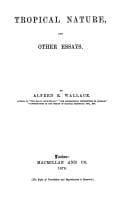
Tropical nature, and other essaysWallace, Alfred Russel
History
Tropical nature, and other essays
Wallace, Alfred Russel
Ecology -- Tropics; Natural history -- Tropics; Tropics
If this view is correct (and it is supported by a considerable amount
of evidence which it is not possible here to adduce), all the great
mammalia which now seem so specially characteristic of Africa--the
lions, leopards, and hyænas,--the zebras, giraffes, buffaloes,
and antelopes,--the elephants, rhinoceroses, and hippopotami,--and
perhaps even the numerous monkeys, baboons, and anthropoid apes,--are
every one of them comparatively recent immigrants, who took
possession of the country as soon as an elevation of the old Eocene
and Miocene sea-bed afforded a passage from the southern borders of
the Palæarctic region. This event probably occurred about the middle
of the Miocene period, and it must have effected a vast change in
the fauna of Africa. A number of the smaller and more defenceless
of the ancient inhabitants must have been soon exterminated, as
surely as our introduced pigs, dogs, and goats, exterminate so many
of the inhabitants of oceanic islands; while the new-comers finding
a country of immense extent, with a tropical climate, and not too
much encumbered with forest vegetation, spread rapidly over it, and
thenceforth, greatly multiplying, became more or less modified in
accordance with the new conditions. We shall find that this theory
not only accounts for the chief specialities, but also explains
many of the remarkable deficiencies of the Ethiopian fauna. Thus,
bears and deer are absent, because they are comparatively late
developments, and were either unknown or rare in Europe till late
Miocene or Pliocene times; while, on the other hand, the immense area
of open tropical country in Africa has favoured the preservation
of numerous types of large mammalia which have perished in the
deteriorated climate and diminished area of Europe.
Our knowledge of the geology of Africa is not sufficiently detailed
to enable us to determine its earlier history with any approach
to accuracy. It is clear, however, that Madagascar was once united
with the southern portion of the Continent, but it is no less clear
that its separation took place before the great irruption of large
animals just described; for all these are wanting, while lemurs,
insectivora, and civets abound,--the same low types which were once
the only inhabitants of the mainland. It is worthy of note, that
south temperate Africa still exhibits a remarkable assemblage of
peculiar forms of mammalia, birds, and insects,--the two former
groups mostly of a low grade of organisation; and these, taken in
connection with the wonderfully rich and highly specialised flora
of the Cape of Good Hope, point to the former existence of an
extensive south-temperate land in which so many peculiar types could
have been developed. Whether this land was separated or not from
Equatorial Africa, or formed with it one great southern continent,
there is no sufficient evidence to determine.
Public-domain text, read in full here on John Shaqi.
Reviews
Reviews
No reviews yet
Be the first to share your thoughts on this work.
Elsewhere in the archive
Join the Discussion
Join the discussion
Sign in to leave a comment or review.
Sign InorCreate an account