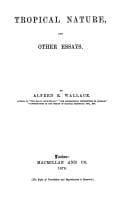
Tropical nature, and other essaysWallace, Alfred Russel
History
Tropical nature, and other essays
Wallace, Alfred Russel
Ecology -- Tropics; Natural history -- Tropics; Tropics
We must not forget, however, that the faunas of the two continents
were always to a great extent distinct and contrasted--such
important Old-World groups as the civets, hyænas, giraffes, and
hippopotami, never passing to America, while the extinct Oreodontidæ,
Brontotheridæ, and many others are equally unknown in the Old World.
This renders it probable that the communication even in the north
was never of long continuance; while it wholly negatives the theory
of an Atlantis bridging over the Atlantic Ocean in the Temperate
Zone at any time during the whole Tertiary period.
But the past history of the North American fauna is complicated by
another set of migrations from South America, which, like those
from the Old World, appear to have occurred at distant intervals,
and to have continued for limited periods. In the Post-Pliocene
epoch, along with elephants and horses from Europe or Asia, we
find a host of huge sloths and other Edentata, as well as llamas,
capybaras, tapirs, and peccaries, all characteristic of South
America. Some of these were identical with living species, while
others are closely allied to those found fossil in Brazilian caves
and other deposits of about the same age, while nothing like them
inhabited the Old World at the same period. We are therefore quite
sure that they came from some part of the Neotropical region; but
the singular fact is, that in the preceding Pliocene epoch none of
them are found in North America. We conclude, therefore, that their
migration took place at the end of the Pliocene or beginning of the
Post-Pliocene epoch, owing to some specially favourable conditions,
but that they rapidly disappeared, having left no survivors. We
must, however, study the past history of South America in order to
ascertain how far it has been isolated from or connected with the
northern continent.
Abundant remains of the Post-Pliocene epoch from Brazilian caves
show us that the fauna of South America which immediately preceded
that now existing had the same general characteristics, but was
much richer in large mammalia and probably in many other forms of
life. Edentata formed the most prominent feature; but instead of
the existing sloths, armadillos, and ant-eaters, there were an
immense variety of these animals, some of living genera, others
altogether different, and many of them of enormous size. There were
armadillos as large as the rhinoceros, while the megatherium and
several other genera of extinct sloths were of elephantine bulk. The
peculiar families of South American rodents--cavies, spiny-rats,
and chinchillas--were represented by other species and genera, some
of large size; and the same may be said of the monkeys, bats, and
carnivora. Among Ungulata, however, we find, in addition to the
living tapirs, llamas, peccaries, and deer, several species of horse
and antelope, as well as a mastodon, all three forms due probably
to recent immigration from the northern continent.
Public-domain text, read in full here on John Shaqi.
Reviews
Reviews
No reviews yet
Be the first to share your thoughts on this work.
Elsewhere in the archive
Join the Discussion
Join the discussion
Sign in to leave a comment or review.
Sign InorCreate an account