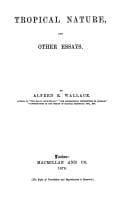
Tropical nature, and other essaysWallace, Alfred Russel
History
Tropical nature, and other essays
Wallace, Alfred Russel
Ecology -- Tropics; Natural history -- Tropics; Tropics
The great land masses of the northern hemisphere thus appear to have
possessed between them all the higher types of animal life; and
these seem to have been developed for a time in one continent and
then to have been in part transferred by migration to the other,
where alone they have sometimes maintained themselves. Thus, the
elephants and the camels appear to have descended from what were once
exclusively American types, while the opossums were as certainly
European. Many groups, however, never passed out of the continent
in which they originated--the civets, hyænas, and the giraffes
being wholly eastern, while the Oreodontidæ and Brontotheridæ were
no less exclusively western.
South America seems to have been united to the northern continent
once at least in Secondary or early Tertiary times, since it was
inhabited in the Eocene period by many forms of mammalia, such as
rodents, felines, and some ancient forms of Ungulata. It must also
have possessed the ancestors of the Edentata (though they have
not yet been discovered), or we should not find such a variety of
strange and gigantic forms of this order in later Tertiary deposits
in this part of the world only. During the greater part of the
Tertiary period, therefore, South America must have been separated
from the North and protected from incursions of the higher forms
of mammalia which were there so abundant. Thus only does it seem
possible to understand the unchecked development of so many large
but comparatively helpless animals as the Edentata of the Pampas
and the Brazilian caves--a development only comparable with that
of the Australian marsupials, still more completely shut off from
all competition with higher forms of life.
Public-domain text, read in full here on John Shaqi.
Reviews
Reviews
No reviews yet
Be the first to share your thoughts on this work.
Elsewhere in the archive
Join the Discussion
Join the discussion
Sign in to leave a comment or review.
Sign InorCreate an account