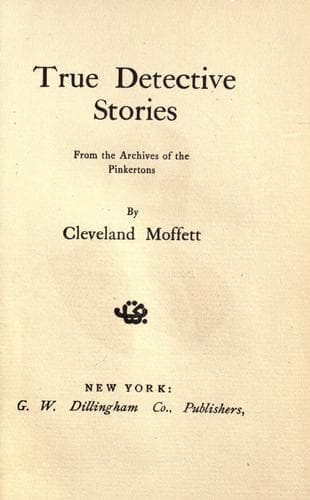
True Detective Stories from the Archives of the PinkertonsMoffett, Cleveland
History
True Detective Stories from the Archives of the Pinkertons
Moffett, Cleveland
Crime -- United States; Criminals -- United States; Detective and mystery stories, American
Thus, from one city to another, and through every part of the country,
any criminal may be "shadowed" to-day as Schwartz was "shadowed," one
set of detectives relieving another every twenty-four hours, and the
man's every word and action be carefully noted down and reported,
without his having the faintest suspicion that he is under
observation. The task of "shadowing" a person who is traversing city
streets is intrusted to men especially skilled in the art (for art it
is) of seeing without being seen. This is, indeed, one of the most
difficult tasks a detective is called upon to perform, and the few who
excel in it are given little else to do. Where a criminal like
Schwartz, upon whose final capture much depends, is being followed,
two, three, or even four "shadows" are employed simultaneously, one
keeping in advance, one in the rear, and two on either side. The
advantage of this is that one relieves the other by change of
position, thus lessening the chance of discovery, while, of course, it
is scarcely possible for several "shadows" to be thrown off the trail
at once. An adroit criminal might outwit one "shadow," but he could
scarcely outwit four. A "shadow," on coming into a new town with a
subject, reveals himself to the "shadow" who is to relieve him by some
prearranged signal, like a handkerchief held in the left hand.
The result of the "shadowing" in Schwartz's case was conclusive. No
sooner was the brakeman out of Chicago than he began spending money
far in excess of his income. He bought fine furniture, expensive
clothing, articles of jewelry, presents for his wife, and laid in an
elaborate supply of rifles, shot-guns, revolvers, and all sorts of
ammunition, including a quantity of cartridges. The "shadows" found
that in almost every case he paid for his purchases with fifty-or
one-hundred-dollar bills. As far as possible these bills were secured
by the detectives from the persons to whom they had been paid,
immediately after Schwartz's departure. It will be remembered that the
money taken in the robbery consisted of fifty-and one-hundred-dollar
bills.
IV
In addition to this, it was found, by the investigations of detectives
at Philadelphia, that Schwartz was the son of a wealthy retired
butcher there, a most respectable man, and that he had a wife and
child in Philadelphia, whom he had entirely deserted. This gave an
opportunity to take him into custody and still conceal from him that
he was suspected of committing a higher crime. The Philadelphia wife
and child were taken on to Chicago, and Schwartz was placed under
arrest, charged with bigamy.
Public-domain text, read in full here on John Shaqi.
Reviews
Reviews
No reviews yet
Be the first to share your thoughts on this work.
Elsewhere in the archive
Join the Discussion
Join the discussion
Sign in to leave a comment or review.
Sign InorCreate an account