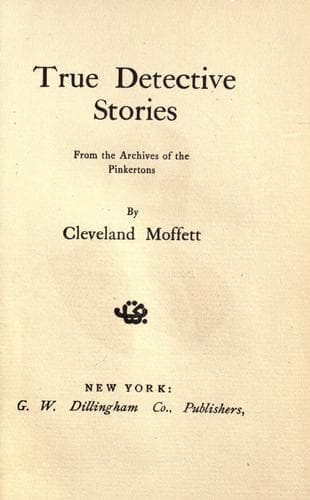
True Detective Stories from the Archives of the PinkertonsMoffett, Cleveland
History
True Detective Stories from the Archives of the Pinkertons
Moffett, Cleveland
Crime -- United States; Criminals -- United States; Detective and mystery stories, American
Mr. Pinkerton went to the jail at once, and, wishing to keep
Schwartz's confidence as far as possible, assured him that this arrest
was not his work at all, but that of detectives Smith and Murray, who
were, as Schwartz knew, working in the interests of the railroad
people and of the Chicago "Daily News." Mr. Pinkerton told Schwartz
that he still believed, as he had done all along, that Watt was the
guilty man, and promised to do whatever he could to befriend Schwartz.
The latter did not appear to be very much alarmed, and said that a
Philadelphia lawyer was coming on to defend him. The lawyer did come a
few days later, when a bond for two thousand dollars was furnished for
Schwartz's reappearance, and he was set at liberty. Matters had gone
so far, however, that it was not considered safe to leave Schwartz out
of jail, and he was immediately rearrested on the charge of murder.
Whether because of long preparation for this ordeal or because he was
a man of strong character, Schwartz received this blow without the
slightest show of emotion, and went back into the jail as coolly as he
had come out. He merely requested that he might have an interview with
his wife as soon as possible.
Mr. Pinkerton had evidence enough against Schwartz to furnish a strong
presumption of guilt; but it was all circumstantial, and, besides, it
did not involve Newton Watt, whose complicity was more than suspected.
From the first Mr. Pinkerton had been carefully conciliatory of the
later Mrs. Schwartz. At just the right moment, and by adroit
management, he got her under his direction, and by taking a train with
her to Morris, and then on the next morning taking another train back
to Chicago, he succeeded in preventing her from getting the advice of
her husband's lawyer, who was meantime making the same double journey
on pursuing trains with the design of cautioning her against speaking
to Mr. Pinkerton. She had come to regard Mr. Pinkerton more as a
protector than as an enemy, and he, during the hours they were
together, used every device to draw from her some damaging admission.
He told her that the evidence against her husband, although serious in
its character, was not, in his opinion, sufficient to establish his
guilt. He told her of the bills found in Schwartz's possession, of the
torn piece of the draft taken from the valise, of the marks on his
hands and the lies he had told. All this, he said, proved that
Schwartz had some connection with the robbery, but not that he had
committed the murder, or done more than assist Watt, whom Mr.
Pinkerton professed to regard as the chief criminal. The only hope of
saving her husband now, he impressed upon her, was for her to make a
plain statement of the truth, and trust that he would use this in her
husband's interest.
Public-domain text, read in full here on John Shaqi.
Reviews
Reviews
No reviews yet
Be the first to share your thoughts on this work.
Elsewhere in the archive
Join the Discussion
Join the discussion
Sign in to leave a comment or review.
Sign InorCreate an account