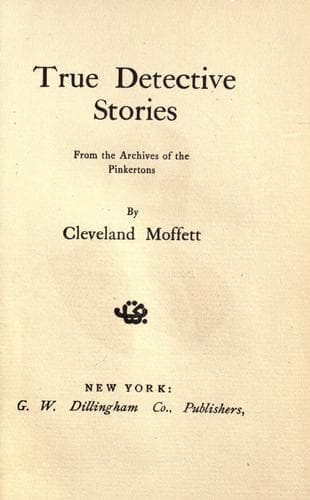
True Detective Stories from the Archives of the PinkertonsMoffett, Cleveland
History
True Detective Stories from the Archives of the Pinkertons
Moffett, Cleveland
Crime -- United States; Criminals -- United States; Detective and mystery stories, American
When organizing the pursuit of Crawford, detective Hotchkiss had
arranged with the Honduras government that any letters and telegrams
that might come addressed to the absconder should be delivered to him.
Several letters were thus secured from the young man about town in New
York who had befriended Crawford so constantly in the past, and who
seemed now disposed to stand by him even in adversity and disgrace.
The letters contained counsel and reproaches, and seemed to indicate
that relations of unusual familiarity had existed between the two men.
Besides these letters, two cablegrams were intercepted from the same
source, both being sent through an intermediary. The first was dated
March 15, 1890, and read: "Tell Crawford go back. Papers bluff. No
treaty exists." The second, sent two days later, read: "Inform
Crawford will meet him in Puerto Cortes."
It is needless to say that the young man did not carry out his
intention of joining Crawford in Honduras, for the same mail which
would have brought him Crawford's reply carried the startling news
that his protege and friend was under arrest in Santa Barbara, a
self-confessed bank robber.
The government of Honduras consented, thanks to their friendly
relations with the Pinkertons, to deliver Crawford over to one of the
representatives of the agency, and superintendent E. S. Gaylor, who
had meantime replaced detective Hotchkiss, took him in charge. A guard
of Spanish soldiers brought the prisoner to Puerto Cortes, where he
was placed in a hotel pending his transfer to a vessel sailing for the
United States. Superintendent Gaylor himself was present to see that
everything was managed properly, and he was seconded in his oversight
by the former Pinkerton employee, the head of the secret police in
Honduras. The final arrangements had been made, the government having
taken advantage of a law authorizing the expulsion of "pernicious
foreigners" in order to get rid of Crawford. The superintendent had
actually taken passage for himself and Crawford, and selected berths,
on an American vessel that was to sail on the morning of May 2, 1890;
but the night before Crawford made his escape from the hotel, going
without the money, which remained in the detective's keeping. How he
escaped is still a matter of conjecture. The hotel stood on the
water's edge, and from a balcony to which Crawford had access he may
have managed to spring down to a wall built on piles. From there he
may have reached the hotel yard at the back, and escaped over one of
the picket fences that separated the hotel from the adjoining
property. There is also a possibility that the Spanish soldiers were
bribed; but this has never been proved, and is scarcely probable, as
Crawford at the time of his escape had not more than seventy-five
dollars in Honduras bills in his possession.
Public-domain text, read in full here on John Shaqi.
Reviews
Reviews
No reviews yet
Be the first to share your thoughts on this work.
Elsewhere in the archive
Join the Discussion
Join the discussion
Sign in to leave a comment or review.
Sign InorCreate an account