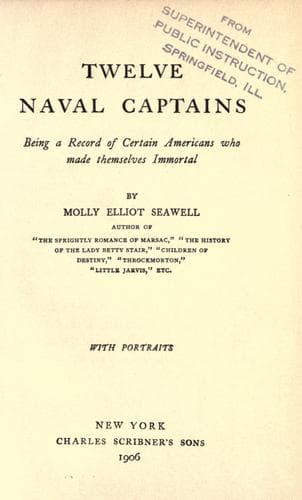
Twelve Naval Captains: Being a Record of Certain Americans Who Made Themselves ImmortalSeawell, Molly Elliot
History
Twelve Naval Captains: Being a Record of Certain Americans Who Made Themselves Immortal
Seawell, Molly Elliot
United States. Navy -- Biography
Indeed, Macdonough's character as an officer and a man is as nearly
perfect as can be imagined; and when his great talents are considered,
he may well be held as a type of what the American naval officer should
be. He entered the navy in 1800, when he was seventeen, which was
rather old for a midshipman in those days. He had enjoyed a good
education for his years, and remained a close student all his life. He
was deeply but not obtrusively religious, and no human being ever heard
a low or profane word from his lips.
Such a young man as Thomas Macdonough must make his mark early, and
from the first his commanding officers reposed the greatest confidence
in him. He was ordered to the Philadelphia, under Captain Bainbridge,
when Commodore Preble went out in 1803 to reduce the African pirates.
He happened to have been detached from the Philadelphia and in command
of a prize at Gibraltar when the unfortunate ship went upon the
rocks near Tripoli, October 31, 1803, and he thus escaped the long
captivity of his shipmates. He reported promptly to Commodore Preble,
and was assigned to the Enterprise, schooner, under Decatur, then a
young lieutenant commandant of less than twenty-five years. It may be
imagined that no officer in the Mediterranean squadron felt a more
ardent desire than Macdonough to rescue Bainbridge and his men and to
destroy the Philadelphia.
At last Decatur organized his celebrated expedition in the ketch
Intrepid, and among the eleven officers he selected for that glorious
enterprise was Macdonough. At that time Macdonough was still a
midshipman. He was tall and very slender, never having been physically
strong; but he was, even then, a man for the post of danger.
The ketch set off on the 3d of February from Syracuse and returned
on the 19th, having in that time entered the well-guarded harbor
of Tripoli by night, burned the Philadelphia at her moorings, and
escaped without losing a man. Macdonough was the third man on the
Philadelphia's deck, and was especially active in his work of
distributing the powder for the ship's destruction in her storerooms
aft. No officer in that glorious expedition conducted himself better
than Macdonough; and when it is remembered that Decatur commanded it,
that James Lawrence was one of his lieutenants, and Charles Morris,
who was afterward Captain Hull's first lieutenant in the escape of
the Constitution and the capture of the Guerrière, was one of the
midshipmen, it will be seen that Macdonough was measured by no common
standard.
Public-domain text, read in full here on John Shaqi.
Reviews
Reviews
No reviews yet
Be the first to share your thoughts on this work.
Elsewhere in the archive
Join the Discussion
Join the discussion
Sign in to leave a comment or review.
Sign InorCreate an account