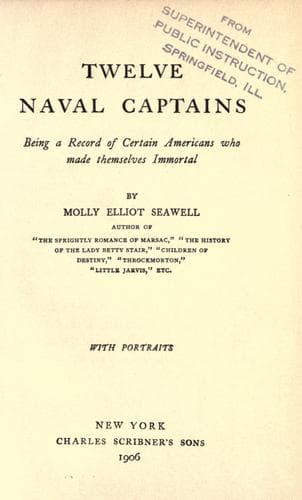
Twelve Naval Captains: Being a Record of Certain Americans Who Made Themselves ImmortalSeawell, Molly Elliot
History
Twelve Naval Captains: Being a Record of Certain Americans Who Made Themselves Immortal
Seawell, Molly Elliot
United States. Navy -- Biography
The New York, with the Adams, frigate, and the little Enterprise, began
the blockade of Tripoli in May, 1803. A number of merchant vessels,
protected by gunboats, ran under the batteries of the old part of the
town, where they were comparatively safe from ships of the draught of
the American squadron. Every preparation was made to defend them, but
Porter, Lawrence, and other brave and daring young spirits determined
to make a dash for them and destroy them if possible. Having got the
commodore's permission, an attacking party was organized under Porter,
with Lawrence as second in command, with three other officers and a
number of picked men. On the morning of the attack the boats advanced
boldly, in the face of a sharp musketry fire, and succeeded in making
a landing. The Tripolitans adopted their usual style of hand-to-hand
fighting, but in spite of it the vessels were fired and the Americans
retired with slight loss. The Tripolitans, by the most tremendous
efforts, put out the fire and saved their vessels; but they discovered
that the Americans were disposed to come to close quarters with them,
which policy finally brought down the power of the Barbary States.
Lawrence, as well as Porter, was particularly distinguished in this
dashing little affair. The next adventure in which Lawrence was engaged
was a few weeks after; the Enterprise being under the command of Hull,
then a lieutenant commandant. It had been determined to hunt up the
Tripolitan ships of war wherever found. The Enterprise was engaged in
this service, and on a June morning, very early, the lookouts from the
Adams, frigate, observed a signal flying from the Enterprise of "Enemy
in sight." A Tripolitan frigate, supported by nine gunboats, trying
to get to sea from Tripoli, had been penned up in a narrow bay by the
Enterprise, which, too weak to attack, signalled for her more powerful
consort to come to her assistance. The Adams responded promptly, the
Enterprise meanwhile maintaining her station with as much daring as if
she were a forty-four-gun frigate instead of a twelve-gun schooner. As
soon as the wind permitted the Adams to get within range, she opened
with terrible effect upon the corsair, which replied vigorously, and
did not strike until she had received the fire of the Adams, in smooth
water and at short range, for three quarters of an hour. Soon after her
colors were hauled down, fire reached her magazine, and she blew up.
It was Lawrence's extreme good fortune, after serving under such a
captain as Isaac Hull, to serve next under Decatur. The Argus, one
of the four handsome little vessels built for the war with Tripoli,
had been sent out under Decatur, who was to exchange her for the
Enterprise, Hull's superior rank entitling him to the larger vessel.
Yet it is remarkable that the little Enterprise, although distinctly
inferior to the other four small vessels, survived every one of them,
and had an unbroken career of success both in running and fighting.
Public-domain text, read in full here on John Shaqi.
Reviews
Reviews
No reviews yet
Be the first to share your thoughts on this work.
Elsewhere in the archive
Join the Discussion
Join the discussion
Sign in to leave a comment or review.
Sign InorCreate an account