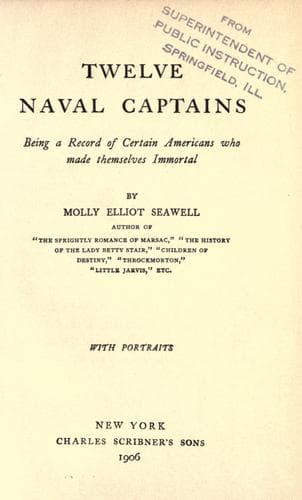
Twelve Naval Captains: Being a Record of Certain Americans Who Made Themselves ImmortalSeawell, Molly Elliot
History
Twelve Naval Captains: Being a Record of Certain Americans Who Made Themselves Immortal
Seawell, Molly Elliot
United States. Navy -- Biography
By the time they reached the Mayor's court, Decatur's temper, never
mild, was red hot. He proceeded to harangue and even to browbeat the
Mayor, who was a very insignificant person compared with Commodore
Decatur. At the first blast, though, the Mayor proved that he had a
spirit of his own. "Look here, Commodore," said he, "when you are on
the quarterdeck of your ship you command. I'll have you understand that
this courtroom is my quarterdeck, and I command here, and if I hear
another disrespectful word from you I'll send you to jail for as long
as I please." Decatur, paralyzed with astonishment, looked at the Mayor
for a long time; then, suddenly bursting into a shout of laughter,
apologized for his behavior and submitted to be fined for thrashing the
policeman.
Such was the man through life,--daring, generous, overbearing
sometimes, but always responding to what was just and courageous in
others.
Decatur's first cruise was made in the United States, frigate,
forty-four guns, wearing the broad pennant of Commodore Barry. Charles
Stewart, afterward the celebrated commodore, was one of the junior
lieutenants of the ship, and the heroic and unfortunate Richard Somers
was one of the midshipmen.
Decatur and Somers had been schoolmates in Philadelphia, and the
association formed there was cemented into a devoted friendship in
the steerage of the United States. No two natures were ever more
dissimilar than that of the impetuous Decatur and the gentle and
retiring but indomitable Somers. From the beginning they were actuated
by a noble professional rivalry; yet their close and affectionate
friendship was that of brothers, and their devotion to each other has
become a tradition in the navy.
The United States was a splendid frigate, fast and weatherly, and, from
the regularity with which she made time on her cruises, was known as
"Old Wagoner." Commodore Barry was an old officer who had done good
service in the Revolution, and when he took command of the squadron of
which "Old Wagoner" was the flagship, he sailed at once for the West
Indies, to retaliate on the French ships which had preyed upon American
commerce. It was not the good fortune of the United States to meet
a frigate of equal force, so that her men and their mettle could be
tried, but she did good service in clearing out the French privateers
which infested those seas. Decatur saw much active cruising, and gave
indications of that dashing courage, masterly seamanship, and fertile
resource which he developed the instant he got command of a ship.
Public-domain text, read in full here on John Shaqi.
Reviews
Reviews
No reviews yet
Be the first to share your thoughts on this work.
Elsewhere in the archive
Join the Discussion
Join the discussion
Sign in to leave a comment or review.
Sign InorCreate an account