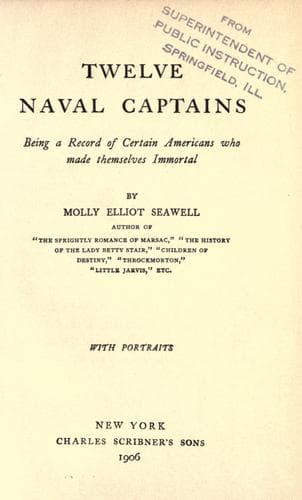
Twelve Naval Captains: Being a Record of Certain Americans Who Made Themselves ImmortalSeawell, Molly Elliot
History
Twelve Naval Captains: Being a Record of Certain Americans Who Made Themselves Immortal
Seawell, Molly Elliot
United States. Navy -- Biography
Preble was in his forty-seventh year when he died. He was tall and
slight, of gentlemanly appearance and polished manners. He left behind
him a reputation for great abilities, used with an eye single to his
country's good, and a character for probity and courage seldom equalled
and never surpassed.
STEPHEN DECATUR
Among the most brilliant and picturesque figures in American naval
history stands Stephen Decatur. His achievements were of that dashing
and splendid quality which leaves a blaze upon the page of history; and
the greatest of them, the destruction of the Philadelphia frigate in
the harbor of Tripoli, earned from Lord Nelson the praise of being "the
most bold and daring act of the age."
Decatur came justly by his genius for the sea. His father was a captain
in the navy of the United States, and his grandfather had been a French
naval officer. His was no rude struggle with adversity. The child of
gentle people, he entered the navy in 1797, with every advantage of
education and training. He was then eighteen years of age,--old for
a midshipman, when boys entered at thirteen and were often acting
lieutenants at sixteen. Decatur was a handsome man, tall and well made.
[Illustration: Stephen Decatur]
Although of a disposition the most generous, he was always of an
impetuous and even domineering nature. Strict habits of self-control
modified this impetuosity, but to the day of his death he was
subject to gusts of temper whenever he came across any instance of
cruelty or meanness or oppression.
A famous example of this was shown shortly before his untimely death.
He was then at the summit of his fame, one of the ranking officers
of the navy, a navy commissioner, and living in grand style for the
times in the city of Washington. He had a favorite dog, and one day,
when the dog was lying quietly asleep on the doorstep of Decatur's
house, a policeman came along and wantonly shot the poor creature.
Decatur happened to see the whole affair, and, rushing out, he gave the
policeman then and there a terrific walloping. The policeman, smarting
from the injury to his dignity as well as the pounding of his bones,
swore out a warrant, and Decatur was commanded to appear before the
Mayor of Washington. Furious at the turn of affairs, Decatur flatly
refused to obey the constable's summons. In vain the officer pleaded
with him to go quietly. Decatur would not budge a step. At last the
man brought a posse and proceeded to take him by force. Decatur would
not be guilty of the crime of resisting the law, but he proposed to
let them get him before the magistrate the best way they could. He not
only would not walk a step, but lay down on the floor, and, as he was
a large and heavy man, it was a job to lift him up and put him in a
carriage; but at last it was accomplished.
Public-domain text, read in full here on John Shaqi.
Reviews
Reviews
No reviews yet
Be the first to share your thoughts on this work.
Elsewhere in the archive
Join the Discussion
Join the discussion
Sign in to leave a comment or review.
Sign InorCreate an account