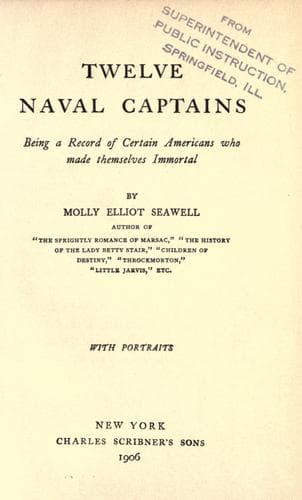
Twelve Naval Captains: Being a Record of Certain Americans Who Made Themselves ImmortalSeawell, Molly Elliot
History
Twelve Naval Captains: Being a Record of Certain Americans Who Made Themselves Immortal
Seawell, Molly Elliot
United States. Navy -- Biography
The Siren, meanwhile, in the offing, had hoisted out her boats, and
was ready to assist the Intrepid, in case she needed it. The progress
of the ketch was plainly visible until she was lost in the shadow
of the Philadelphia's black hull. In a few minutes a single rocket
skyward showed the anxious watchers that the Philadelphia was boarded;
and almost at once the blaze rushed up the rigging, and enveloped
the tall hull, lighting up the night with a lurid glare, while the
guns of the doomed frigate and those of the castle, the ships, and
the forts thundered out. Then they knew that the great enterprise was
accomplished. The boats pulled toward the harbor entrance; soon the
ketch had shot across the illuminated water, and had reached them.
Decatur, jumping into one of the Siren's boats, was quickly pulled
toward the brig. Stewart, standing in the gangway, saw the boat
approach, and a man, in a sailor's round jacket and a fez, sprang over
the gangway, into his arms. It was Decatur.
Fifteen days after leaving Syracuse, the ketch and the brig were
seen standing in the harbor, the signal of success flying from the
Intrepid's masthead. For this splendid adventure Decatur was made a
post-captain, his commission dating from the 16th of February, and the
officers and men were rewarded.
Before, however, receiving his commission, Decatur was yet to do
glorious things in the bombardment of Tripoli during the following
summer. Commodore Preble, in arranging the boat attacks, which he
supported by the batteries of the "Old Ironsides," and all his brigs
and schooners, gave the command of the right division to Richard
Somers, Decatur's bosom friend, and the left division to Decatur. On
the 2d of August the first attack was made. The Tripolitans had a
flotilla of fourteen gunboats to resist the six the Americans could
muster; and they had, in reserve, behind the rocks in the harbor,
five more gunboats and several heavy galleys, besides their forts,
batteries, and larger clubs. The attack was begun about half past
one in the afternoon, the whole force standing in; the Constitution
approaching as close as possible and pouring in many broadsides against
the forts, the brigs and schooners supporting the gunboats, while the
latter dashed at the Tripolitan gunboats and galleys with a swiftness
and impetuosity that were simply tremendous. The attack soon assumed
a character of hand-to-hand fighting that is seldom seen in modern
days. Decatur's own vessel laid aboard a large Tripolitan gunboat,
and in spite of the most desperate resistance, grappled with her. She
was divided in the middle by a long narrow hatchway, and in this the
Tripolitans mustered to drive back the Americans when they entered.
Immediately Decatur was over the side, followed by his lieutenant, Mr.
Thorne, by Macdonough, and all the Americans in the gunboat's crew.
They advanced together with pikes and cutlasses, and then ensued a
Public-domain text, read in full here on John Shaqi.
Reviews
Reviews
No reviews yet
Be the first to share your thoughts on this work.
Elsewhere in the archive
Join the Discussion
Join the discussion
Sign in to leave a comment or review.
Sign InorCreate an account