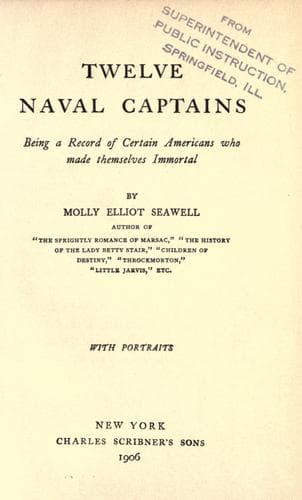
Twelve Naval Captains: Being a Record of Certain Americans Who Made Themselves ImmortalSeawell, Molly Elliot
History
Twelve Naval Captains: Being a Record of Certain Americans Who Made Themselves Immortal
Seawell, Molly Elliot
United States. Navy -- Biography
At another time, taking a fancy to a regimental band which came
aboard the Boston in an Italian port, he sailed for America with the
musicians, and it was several years before they were all returned to
Italy.
The Boston soon after this returned to the United States, and the
administration of the navy winked at Captain McNeill's peccadilloes, in
view of the actual service he had done during his memorable cruise.
It was at this time that the government determined to send a force out,
under Commodore Preble, to crush Tripoli. Somers got the command of
the Nautilus, one of the four small vessels that were built and sent
out, Stewart getting another, and Decatur a third. Somers was now in
his twenty-fifth year, handsome, well made, and his naturally dark skin
still darker from wind and sun. His manners were polished, and he was
as prepossessing, in his quiet way, as the dashing Decatur. Somers's
black eyes were noticeably melancholy, and after his untimely death
those who loved him fancied they had always seen in his countenance
some premonition of his doom.
The officers who were to command these little vessels superintended
their building, as there were then no regular navy-yards in the
country. The Nautilus, under Somers's command, was the first to
sail, and the first to arrive at Gibraltar, in July, 1803. She was
a beautiful little schooner, of twelve guns, with a crew of nearly
a hundred men. She was, however, very small to cross the Atlantic,
and several times during the voyage Somers was hailed and offered
assistance by friendly shipmasters, who thought the gallant little
vessel must have been blown out of her course.
Somers was one of the boy captains whose youth so disgusted Commodore
Preble when he met them first on their arrival at Gibraltar. But the
commodore found in Somers, as early as with any, the stuff of which
these young officers were made. Somers was very actively engaged in the
labors and cruises which occupied the winter of 1803-4, preparing to
attack Tripoli in the summer. He sympathized ardently with Decatur in
the splendid exploit of the destruction of the Philadelphia. He was
anxious to assist him with the Nautilus, but Stewart's superior rank
and larger command entitled him to support Decatur, which he did in the
Siren. Decatur's success inspired every young captain in the squadron
with a noble desire to equal it, and none more than the quiet and
self-contained Somers.
The preparations for the bombardment of Tripoli continued, and on the
3d of August the first attack took place. Commodore Preble gave the
command of the right division of gun-vessels to Somers, and the left to
Decatur. Somers was supposed to be Decatur's senior at the time, but
the post-captain's commission which the Congress had given Decatur as
a reward for the destruction of the Philadelphia was then on its way,
and arrived a few days after; while the same ship brought Somers's
promotion to a master commandant.
Public-domain text, read in full here on John Shaqi.
Reviews
Reviews
No reviews yet
Be the first to share your thoughts on this work.
Elsewhere in the archive
Join the Discussion
Join the discussion
Sign in to leave a comment or review.
Sign InorCreate an account