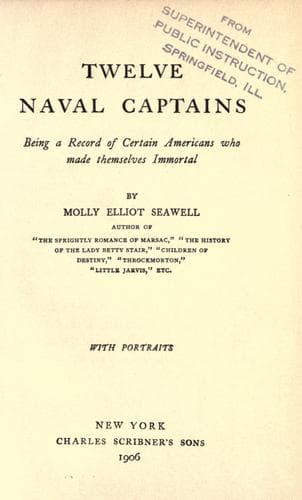
Twelve Naval Captains: Being a Record of Certain Americans Who Made Themselves ImmortalSeawell, Molly Elliot
History
Twelve Naval Captains: Being a Record of Certain Americans Who Made Themselves Immortal
Seawell, Molly Elliot
United States. Navy -- Biography
His first cruise was made in the ship in which he was afterward to
win such splendid renown,--the Constitution. She was then commanded
by Captain Samuel Nicholson. He remained in her for more than two
years, and thus became thoroughly familiar with the great frigate,--a
knowledge he was eventually to put to good use. In 1800 she was the
flagship of Commodore Talbot, in the West Indies, and Hull was her
first lieutenant. Commodore Talbot and the captain of a British frigate
on that station were friends, and the American and British captains
would often discuss the sailing qualities of their respective frigates,
the British ship being a good sailer as well as the Constitution. At
last a sailing-match was agreed upon, the captains wagering a cask
of wine on the result. The two frigates started with a fresh breeze
at sunrise, and the contest was to last until the sunset gun was
fired. Hull sailed the Constitution, and his seamanship on that day
of friendly rivalry was scarcely inferior to that which he displayed
when Admiral Broke's squadron of five ships was hounding him on an
August day, twelve years after. The Constitution could easily leg
it at an eleven-knot gait, with a tolerable breeze, and was almost
unapproachable on a wind; but that day, under Hull's skilful handling,
she outdid herself, and beat her opponent by several miles. Hull
kept the crew on deck the livelong day, and the seamanlike manner in
which he beat the English frigate, which was also remarkably well
sailed, won the admiration even of his opponents. Hull was too great
a seaman himself to underrate either British skill or pluck, and many
years after it is told of him that, speaking with a very steady old
boatswain, the man remarked, "The British, sir, are hard fellows on
salt water."
"I know that,--they are a hard set of fellows, sure enough," was Hull's
emphatic reply.
Hull saw no very brilliant service during the hostilities with France
in 1799-1800, but he cut out a French letter-of-marque in the harbor of
Port Platte, Hayti, in a very handsome manner. He armed a small vessel,
the Sally, with men from the Constitution, ran into the harbor in broad
daylight, landed a company of marines, who spiked the guns of the fort
and carried off the French letter-of-marque in fine style.
In 1802 Hull went to the Adams, of twenty-eight guns, as her first
lieutenant. The Adams was one of the fastest frigates that ever
floated, and Hull was the man to get the most out of her. She was sent
to the Mediterranean at the beginning of the Tripolitan troubles,
and in her patrol of the Straits of Gibraltar in all weathers, and
her blockade of Tripoli in the dangerous winter season, her first
lieutenant splendidly sustained the reputation he had brought from the
Constitution with him, as one of the ablest seamen in the navy. He
would carry more sail than any other lieutenant in the squadron would
have carried, and would make sail when most ships scarcely showed a rag
of canvas.
Public-domain text, read in full here on John Shaqi.
Reviews
Reviews
No reviews yet
Be the first to share your thoughts on this work.
Elsewhere in the archive
Join the Discussion
Join the discussion
Sign in to leave a comment or review.
Sign InorCreate an account