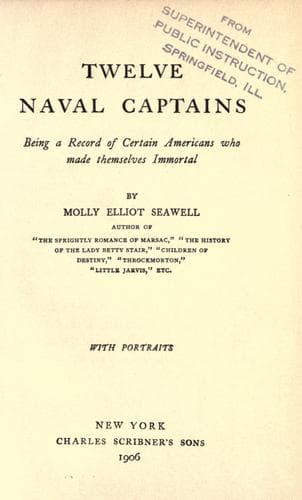
Twelve Naval Captains: Being a Record of Certain Americans Who Made Themselves ImmortalSeawell, Molly Elliot
History
Twelve Naval Captains: Being a Record of Certain Americans Who Made Themselves Immortal
Seawell, Molly Elliot
United States. Navy -- Biography
The wind was light and variable, so that the American vessels came out
slowly; but the little British squadron waited with their topsails to
the mast, until a quarter to twelve, when the first shot was fired by
the Detroit. In a very little while the action became general, each
American and British vessel bravely doing its best to get alongside its
enemy. It was the effort of the gallant commanders of the American and
British squadrons to fight flagship to flagship; and in doing this,
Perry, in the Lawrence, drew ahead of his column, and concentrated upon
his ship the fire from the Detroit and two other vessels. The British
fought their batteries with unusual skill, and the result soon was that
a dreadful slaughter took place on the Lawrence's decks, her guns were
silenced, and she was so much cut up that she was totally unmanageable.
But Perry, with indomitable courage, continued the fight. He himself,
with the help of the purser and the chaplain, fired the last gun
available on the Lawrence. Her consort, the Niagara, approached about
this time, the wind sprang up, and Perry, seeing that the battle was
passing ahead of him, determined to abandon his own unfortunate ship
and make for the Niagara. He ordered a boat lowered, and, taking with
him his brother, a little midshipman of thirteen years old, he was
rapidly pulled to the Niagara. Once on board of her, he bore up, and
soon got her into a position to rake both the Detroit and the Queen
Charlotte with fearful effect. These two vessels, after an heroic
defence, were compelled to strike, while the seven smaller American
gunboats soon overpowered the four British ones. The Detroit, however,
before striking had forced the Lawrence to haul down her colors; and
the fight, as all the others during this war, was as creditable to
British as to American valor.
The first news of the victory was in Perry's celebrated despatch: "We
have met the enemy, and they are ours." The news from the Canadian
border had not always been gratifying, and on that account the American
people were the more delighted at this success. Perry was given a gold
medal and promoted to be a post-captain; for although he had been
called commodore by courtesy, such was not his real rank at the time.
Perry had no further opportunity of distinguishing himself before peace
was declared, in January, 1815. He obtained afterward some of the
best commands in the navy, and in March, 1819, he became a commodore
in fact, by being given the command of a squadron in South America
destined to protect American trade in those quarters. He hoisted his
broad pennant on the John Adams, and sailed in June. He reached the
mouth of the Orinoco River in August, and, although it was in the midst
of the sickly season, he determined to go up the river to Angostura.
He shifted his flag to the Nonesuch, schooner, and sent the frigate to
Trinidad.
Public-domain text, read in full here on John Shaqi.
Reviews
Reviews
No reviews yet
Be the first to share your thoughts on this work.
Elsewhere in the archive
Join the Discussion
Join the discussion
Sign in to leave a comment or review.
Sign InorCreate an account