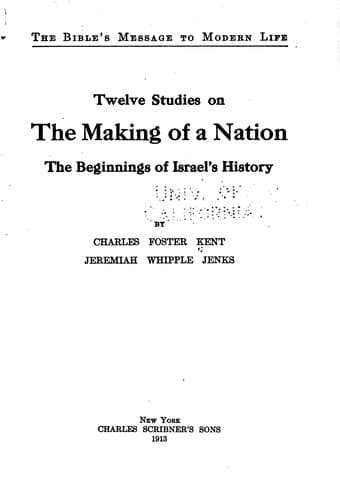
Twelve Studies on the Making of a Nation: The Beginnings of Israel's HistoryKent, Charles Foster
Religion
Twelve Studies on the Making of a Nation: The Beginnings of Israel's History
Kent, Charles Foster
Jews -- History
The home of the Hebrews at this time, like that of the modern
Arabs, was the tent. The stories that have come down from this
period suggest the experiences through which they passed. The
constant insistent problem in this region was and is how to secure
adequate supplies of food and water. During the greater part of
the year the chief food of the people is the milk and curds
supplied by their herds. At times, however, these fail to meet the
needs even of the modern Bedouin inhabitants of this South Country.
They then gather the gum that exudes from the tamarisk tree or the
lichens from the rocks. From these they make a coarse flour and
bread which keeps them alive until the winter rains again bring
their supply of water and pasturage. Some scholars hold that this
coarse food was the manna of the Biblical accounts. They argue
that later generations, familiar with the barrenness of the
wilderness and believing that the Hebrews at this time numbered
many thousands, naturally concluded and reported that their
ancestors were miraculously fed. At certain periods, also, the
meagre fare of the desert dweller is supplemented by the quails
which he is able to capture and these are a welcome relief to his
monotonous diet. About the perennial springs, which gush forth
from the barren rock, there also grew up stories of a miraculous
provision for the needs of Jehovah's people; for all springs and
especially those in the desert were regarded by the ancients as
miracles. Even in more fertile lands the Greeks reared beside such
springs temples to the god, whom they thought of as thus signally
revealing himself. In the deeper sense each of these early Hebrew
stories is historical, for they all record the fundamental thought
and belief that through this strenuous, painful period, even as in
later crises in their history, Jehovah was guiding his people and
giving them not only food and water, but also that training in the
school of danger and privation which was essential for their
highest development.
Even more insistent than the constant struggle for food and water
were the dangers that came from the hostile tribes which already
occupied this much-contested territory. For the possession of the
springs and pasture lands they fought with the energy and craft
that characterize the Bedouin tribes to-day. Hence, to the
Hebrews, fresh from the fertile fields of Egypt, their life in the
wilderness represented constant hardship, privation, suffering and
danger.
II.
INFLUENCE OV THE NOMADIC LIFE UPON ISRAEL'S CHARACTER AND IDEALS.
The wilderness left a stamp upon Hebrew character and life that may
be traced even to-day in the later descendants of that race. It
tightened their muscles and gave them that physical virility which
has enabled them to survive even amidst the most unfavorable
conditions. It taught them how to subsist on the most meagre food
supply and to thrive where the citizen of a more prosperous land
would inevitably starve.
Public-domain text, read in full here on John Shaqi.
Reviews
Reviews
No reviews yet
Be the first to share your thoughts on this work.
Elsewhere in the archive
Join the Discussion
Join the discussion
Sign in to leave a comment or review.
Sign InorCreate an account