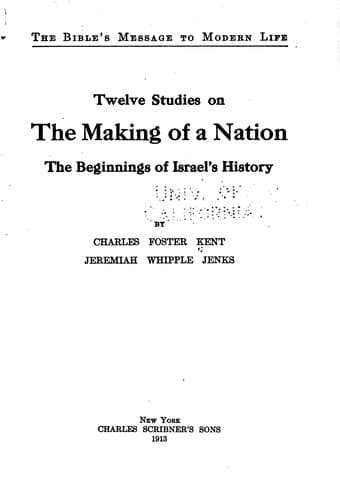
Twelve Studies on the Making of a Nation: The Beginnings of Israel's HistoryKent, Charles Foster
Religion
Twelve Studies on the Making of a Nation: The Beginnings of Israel's History
Kent, Charles Foster
Jews -- History
As later generations meditated on the perils of the wilderness
through which their ancestors passed, they naturally felt that only
under the immediate guidance of a divine power could they have
escaped. They were familiar with the way in which the caravans
travel through the desert: in front of the leader is borne aloft a
brazier filled with coals. From this smouldering fire there arises
by day a column of smoke that, in the clear air of the desert, can
be easily seen afar by any who may straggle behind. At night these
glowing coals seem like a pillar of fire, telling of the presence
of their leader and protector. With the same vivid imagery,
according to some interpreters, the later Hebrews pictured the
march of their ancestors through the wilderness, and thereby
symbolized the belief that Jehovah was then present and that
through his prophet Moses he was personally guiding his people.
How far have these Old Testament narratives been thus interpreted
by modern western readers? Does it change their spiritual
significance to seek to learn their origin and real literary
character? Are there still to be found, often in humble walks of
life, earnest Christians who have similar deep spiritual
experiences and describe them with the same vivid imagery and
concreteness? Is the value of our conception of God's presence and
activity in human history deepened and strengthened or lessened by
the thought that in the past, even as to-day, he accomplished his
ends by natural rather than contra-natural methods? Are the faith
and institutions of nations and individuals developed most through
special revelations or through ordinary, constant, daily training
and experience? Is it not true that to us all there come at times
experiences akin to those that underlie these wonderful narratives?
IV.
THE SIGNIFICANCE OF THE EAST-JORDAN CONQUESTS.
Desert dwellers take little account of the lapse of time. It is
not strange that the data regarding the duration of the sojourn in
the wilderness are late and exceedingly vague. The number forty in
the Bible is the concrete Hebrew equivalent of many. Ordinarily
the forty years represent a generation. A period of about forty
years accords well with the facts of contemporary Egyptian
chronology. If the Hebrews fled from Egypt about 1200, during the
period of anarchy following the breakdown of the nineteenth
Egyptian dynasty, they could not have entered Palestine much before
the middle of the twelfth century, for Ramses III of the Twentieth
Dynasty succeeded in re-establishing and maintaining his authority
in Southern Palestine until his death about 1167 B.C.
Public-domain text, read in full here on John Shaqi.
Reviews
Reviews
No reviews yet
Be the first to share your thoughts on this work.
Elsewhere in the archive
Join the Discussion
Join the discussion
Sign in to leave a comment or review.
Sign InorCreate an account