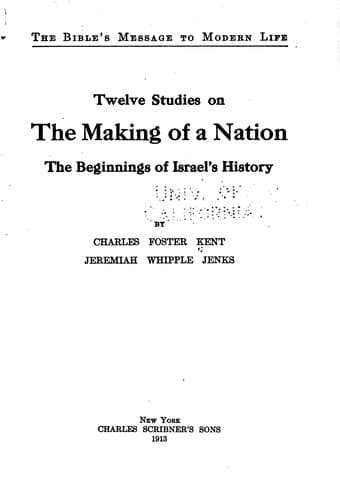
Twelve Studies on the Making of a Nation: The Beginnings of Israel's HistoryKent, Charles Foster
Religion
Twelve Studies on the Making of a Nation: The Beginnings of Israel's History
Kent, Charles Foster
Jews -- History
It is interesting and important to note that Israel's history was
in most respects like that of other growing nations. In the
beginning pastoral society and tribal government develop among
savages primarily through the domestication of animals. The young
of the animals slain in the hunt are kept first as pets: then, when
as a result of the thriftless nature of the savages supplies at
times become scarce, the pets are slain for food. As pets become
more common and population increases, the advantage of breeding for
use is apparent, and private property, in distinction from
community possessions, appears. The growing herds naturally
develop the need of regular service. To meet this need the
institutions of permanent marriage and bondage arise and the wife
or wives and the slaves perform the added work. With the custom of
fixed marriage and the possibility of tracing ancestry through the
father, comes in time ancestral government. The Hebrews seem to
have had this type of government, even in the days of Abraham; and
it lasted until the tribes broke up into clans and families, when
they acquired permanent homes and became agriculturists in the land
of Canaan.
Many of the characteristics of the tribe disappear almost entirely,
as wandering nomads settle in a fixed abode, and the patriarchal
rule changes to that of a royal or democratic government. Customs
become fixed in formal statutes. Property in land becomes more
important than that in herds. War becomes the business of a
special army, instead of the frequent duty of all.
But in the tribe there is little competition. All work for the
community, or for the family, rather than for individual interests.
Each man is primarily responsible, not to the state, but to the
head of his family or clan, who in turn answers for his family to
the tribal chief.
Certain of these tribal institutions and ideals have left their
indelible impress on modern society. The tribe was exclusive.
All those not born into the tribe had no right, no welcome there,
for their coming would tend to restrict the common pasturage. They
would be a burden. Though the tent-dweller might be hospitable to
a guest, an alien had no rights except on sufferance. If he were
needy and were received, he usually became a serf or slave. And
yet this exclusiveness is the germ of our patriotism, a noble trait
that may ultimately, but not soon, be replaced by a cosmopolitan
love for humanity.
Allied to this is the personal bond, that obtains in the tribe,
instead of the territorial unity of the modern state. A Frenchman
is such because he is born in France; an Israelite is such because
he is the son of Abraham and knows his people as his blood kinsmen.
Public-domain text, read in full here on John Shaqi.
Reviews
Reviews
No reviews yet
Be the first to share your thoughts on this work.
Elsewhere in the archive
Join the Discussion
Join the discussion
Sign in to leave a comment or review.
Sign InorCreate an account