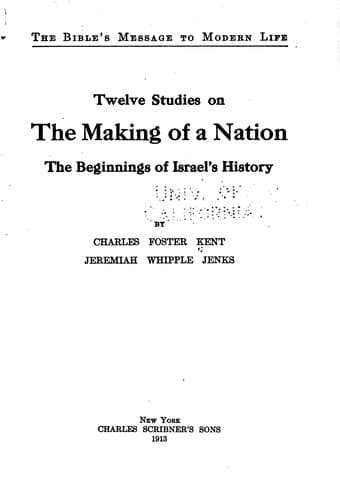
Twelve Studies on the Making of a Nation: The Beginnings of Israel's HistoryKent, Charles Foster
Religion
Twelve Studies on the Making of a Nation: The Beginnings of Israel's History
Kent, Charles Foster
Jews -- History
It is interesting to note in this connection that a reliable Moslem
historian states that in the year 1257 A.D. the retreating Moslems
found it neccessary to repair the foundations of an important
bridge which stood at this point. When the workmen arrived on the
scene they were amazed to find the riverbed empty and were able by
working rapidly to complete the repairs before the waters came
rushing down. This remarkable phenomenon seemed to them to be due
to the direct intervention of Allah; but the historian fortunately
records the cause: it was a huge landslide a little further up the
river which temporarily dammed its waters. The oldest Biblical
account of the crossing of the Jordan may point to a like natural
cause. If this be true, does it imply that Jehovah had no part in
preparing the way for the future conquests of his people? Would a
miracle, such as that recorded in the late-priestly tradition, be
any stronger proof of God's presence and activity in human history
than are the provisions which we to-day call natural?
II.
THE CANAANITE CIVILIZATION.
Contemporary inscriptions and recent excavations make it possible
to form a very definite conception of conditions in Canaan when the
Hebrews crossed the Jordan. The dominant civilization was that of
the Canaanites, the descendants of the Semitic invaders from the
desert who entered Palestine centuries before the ancestors of the
Hebrews. Naturally they settled first along the fertile coast
plains that skirt the western Mediterranean. In later times these
were known as the Phoenicians. As the population increased, the
Canaanites pushed their outposts along the broad valleys that
penetrated the uplands of Palestine. These valleys were especially
fertile and attractive in the territory later known as Galilee and
Samaria. The wide Plain of Esdraelon and its eastward extension,
the Valley of Jezreel, cut straight across the central plateau of
Palestine. The Plain of Esdraelon was the strongest centre of the
Canaanite civilization. A few outposts were established in the
Jordan valley, as for example, Laish, later known as Dan, at the
foot of Mount Hermon, and Jericho, at the southern end of the
Jordan valley. Only a few Canaanite villages were found along the
more barren hills of Southern Canaan. There the peoples and
civilization still retained the imprint of their desert origin.
Public-domain text, read in full here on John Shaqi.
Reviews
Reviews
No reviews yet
Be the first to share your thoughts on this work.
Elsewhere in the archive
Join the Discussion
Join the discussion
Sign in to leave a comment or review.
Sign InorCreate an account