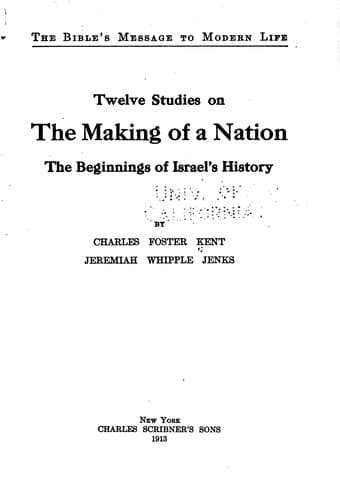
Twelve Studies on the Making of a Nation: The Beginnings of Israel's HistoryKent, Charles Foster
Religion
Twelve Studies on the Making of a Nation: The Beginnings of Israel's History
Kent, Charles Foster
Jews -- History
The compelling power that finally brought all the rival Hebrew
tribes together under a common leader was the conquest of their
territory by the warlike, ambitious Philistines. In inspiring the
Benjamite chieftain Saul to deliver his countrymen in their hour of
shame and peril, Samuel the prophet proved the true father of the
Hebrew kingdom. Under the compulsion of common danger the
Israelites not only followed Saul to victory, but also made him
their king. From this time on Israel took its place among the
nations of the earth.
During their formative period the Hebrews acquired many
characteristics that they have retained throughout their history.
From their early nomadic life they inherited physical strength,
hardihood, adaptability even to the most unfavorable environment,
courage, perseverance and that individual initiative and
self-reliance which come from protracted struggles against
seemingly insuperable odds. It was a harsh but thorough school in
which the infant nation Israel was trained. Their life in the
wilderness and in the period of settlement also developed an
intense love for freedom and that democratic spirit that was the
glory of Israel and the foundation of its political institutions.
People passing their time chiefly out of doors and enjoying the
uplifting stimulus of an unfettered life in the open naturally
acquire a feeling of awe and reverence for the God of nature that
is often lacking in the city dweller. Especially is this true if,
like the early Hebrews, the dwellers in the open feel that need of
divine protection which is begotten by constant exposure to danger,
hunger, hardship and hostile foes. The many crises and the signal
deliverances that came to the Hebrews not only intensified their
faith, but also gave them the consciousness that the God in whom
they put their trust was both able and eager to deliver them.
Prophets like Moses strengthened the popular sense of Jehovah's
immediate presence and interpreted the significance of each event.
Israel's early faith was simple, like that of a little child.
While its beliefs were crude, its trust was strong. It was this
trust and loyalty that carried the child nation through its early
crises and ultimately bound together the separate tribes into a
united commonwealth. Thus Israel's early history illustrates the
fundamental truth, that the most essential, the most powerful force
in the making of a nation is a simple, practical, every-day
religion.
_Questions for Further Consideration_.
Should the successful and easy crossing of the Jordan by the
Israelites be ascribed to miracle or to their own promptness in
seizing an opportunity unexpectedly offered?
In what ways did the religious zeal of the ancient Hebrews in
battle differ from the fanatical zeal of the modern Moslem in
fighting the Christians? Or the zeal of the Japanese before Port
Arthur?
When, if ever, is assassination justifiable as a political
expedient? Give your reasons.
Public-domain text, read in full here on John Shaqi.
Reviews
Reviews
No reviews yet
Be the first to share your thoughts on this work.
Elsewhere in the archive
Join the Discussion
Join the discussion
Sign in to leave a comment or review.
Sign InorCreate an account