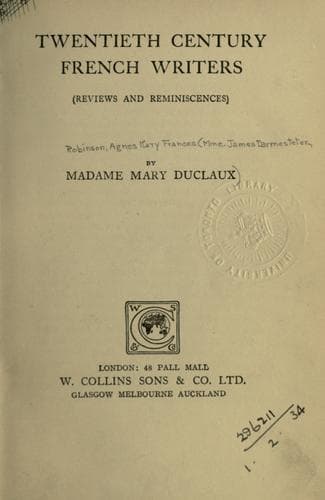
Twentieth Century French Writers: Reviews and ReminiscencesRobinson, A. Mary F. (Agnes Mary Frances)
History
Twentieth Century French Writers: Reviews and Reminiscences
Robinson, A. Mary F. (Agnes Mary Frances)
French literature -- 20th century -- History and criticism
In her second play, _Le Redoubtable_ (produced at the Odéon
Theatre in January, 1912, and withdrawn by the author after three
representations), Mlle Lenéru shows still more forcibly the monstrous,
the almost cancerous growth that a too exasperated personality may
become in an organised community of mediocrities.
Georges Malte is the most brilliant naval officer of his promotion;
all that an individuality can acquire and possess in one generation, he
has acquired, he possesses. But nothing else, neither traditions, nor
inherited breeding, nor the instincts of a gentleman, nor even fortune;
Malte is the son of an Italian pastrycook, and no more French by birth
than Napoleon, or Zola, or Gambetta--who, after all, were pretty
tolerable Frenchmen. And his soul is devoured with ambition for the
refinements he does not inherit; and his mind is consumed by the desire
to be first, by that _amor dominandi_ which is, in certain natures, the
strongest passion of all.
And his heart is wholly occupied by the mistress he adores, who is,
most simply and most naturally, all that he can never be: the child of
a ruling race. Laurence Villaret is the daughter of one admiral, the
wife of another. For six years she and her lover have belonged to each
other in secret, and at length the time comes when Malte (who in his
love of supremacy has affected the rich man) feels his creditors close
upon him and disgrace near at hand. Money he must have or farewell to
his career, good-bye to the love of his life.
Unfortunately, a brilliant officer has always at his disposal one
means of raising funds--if he listen to temptation. And Malte listens.
He communicates to a foreign power certain secrets, and the good ship
_Redoubtable_ is rendered worthless--just as the _Affranchis_ were
not free; just as _La Triomphatrice_ will be shown to be an unloved,
broken-hearted, solitary woman. All Mlle Lenéru’s titles are epigrams
of irony! Yet, in _Le Redoubtable_, Mlle Lenéru has given us the
_reductio ad absurdum_ of her former theme. If, at the close of the
_Affranchis_, we doubted whether the lovers were wise in sacrificing
their utmost joy ‘au bon gouvernement du monde’ (and such is the
contagious force of passion that we had left the theatre happier after
seeing them elope to some undreamed of isle), we doubt no longer when
we have seen _Le Redoutable_.
Although we may admit that the moral law is in process of evolution,
though we may look forward to a day when a new vital order shall
supplant our established order, yet, meanwhile, we must observe the
rules of the game, even though they mean no more to us than the
rules of a game! In fact, however we choose to _think_, there is
but one profitable way of _living_: that which consists in treating
as fundamentally true those truths alone which have weathered the
experience of generations. _Foris ut moris, intus ut libet._ Or as
Pascal puts it: ‘Il faut dire comme les autres, mais ne pas penser
comme eux.’
Public-domain text, read in full here on John Shaqi.
Reviews
Reviews
No reviews yet
Be the first to share your thoughts on this work.
Elsewhere in the archive
Join the Discussion
Join the discussion
Sign in to leave a comment or review.
Sign InorCreate an account