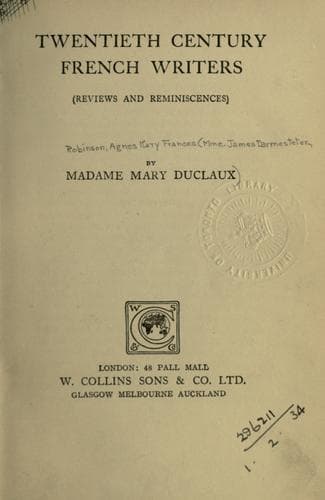
Twentieth Century French Writers: Reviews and ReminiscencesRobinson, A. Mary F. (Agnes Mary Frances)
History
Twentieth Century French Writers: Reviews and Reminiscences
Robinson, A. Mary F. (Agnes Mary Frances)
French literature -- 20th century -- History and criticism
The boldest of the bold is Chantecler, the cock of Gaul. In his legend
of Chantecler, Edmond Rostand bids us mark that courage needs more
to its making than mere temerity. He does not say, with Danton, ‘De
l’audace, de l’audace, et toujours de l’audace.’ He says, ‘De l’audace,
et puis du bon sens, et puis le sens de la vérité!’
This history of a poultry-yard has somewhat disconcerted the adorers
of _Cyrano_. But Boileau and the big-wigs of the Court of Louis
Quatorze were doubtful at first (and thought that Pegasus had taken to
pedestrian by-ways) when La Fontaine produced his inimitable _Fables_;
and only a few years ago in London the public, expectant of more _Plain
Tales from the Hills_, gave a hesitating reception to that _Jungle
Book_ of Mr Kipling’s which already (in France at least) is regarded as
his principal title to honour. There are always amateurs who insist on
repetition, and blame Wouvermans if he paint a picture without a white
horse in it. To my thinking, Edmond Rostand proved himself a poet in
looking no further than the farm-yard gate to find a subject for his
verse.
There is something singularly impressive to the dreamer, to the man
of imagination, in the certainty that our world is inhabited by a race
of beings who see the things we see, and move in the circles wherein
we have our being, but look on everything from a different point of
view, and perhaps with different senses. Ants, that have no ears, yet
hear through their feet, perceiving the vibrations conveyed by solid
bodies; flies, whose innumerable eyes discern the X-rays as a colour;
these, and homing swallows, are more mysterious than fairies. In the
eye of a mystic, a cock is no less wonderful than a ghost; a mouse
than a muse; a primrose by the river’s brim than the herb moly (that
white-blossomed flower which Hermes gave to Ulysses), or than the plant
called Love-in-Idleness that charmed Titania’s eyes. The fact that so
immense a variety of existences shares with us the boon of life, and
feels the same sun, is a perpetual fable to a certain order of minds,
who may affirm with Chantecler:--
‘Et quant à moi, Madame, il y a bien longtemps
Qu’un râteau dans un coin, une fleur dans un vase.
M’ont fait tomber dans une inguérissable extase,
Et que j’ai contracté devant un liseron
Cet émerveillement dont mon œil reste rond!’
This was Rostand’s attitude during the first two acts, the two acts
in which he showed himself a poet. There is a humour, a tenderness, a
charm which recall Hans Andersen’s inimitable stories in his vision of
a world where none of our thoughts, none of our knowledge, but perhaps
most of our feelings have free play. Man is absent.
‘Malebranche dirait qu’il n’y a plus une âme;
Nous pensons humblement qu’il reste encore des cœurs.’
Public-domain text, read in full here on John Shaqi.
Reviews
Reviews
No reviews yet
Be the first to share your thoughts on this work.
Join the Discussion
Join the discussion
Sign in to leave a comment or review.
Sign InorCreate an account